FOR FREEDOM
LITHUANIAN AMERICAN SUPPORT OF LITHUANIA’S INDEPENDENCE AND RECOGNITION
This exhibit explores Lithuanian Americans’ passionate and energetic support for the cause of Lithuania’s independence 100 years ago. Using photographs, documents, publications, and other historical artifacts that exhibition begins with an overview of Lithuania state at the dawn of the 20th century as as subjugated part of the Russian Empire. A second preparatory section gives a brief portrayal of Lithuanian American communities in America and summarizes their significant cultural, political, and financial achievements. The exhbition’s central focus is the vital role played by Lithuanian Americans as their native land seized a unique and complex opportunity to end its 125-year Russian subjugation. This exhibition demonstrates that Lithuanian Americans’ support for freedom in their native land did not end with the declared independence in 1918 nor with its recognition by the United States in 1922. In fact, as the exhibition shows, Lithuanian Americans’ supported their native land’s recurrent struggles to achieve freedom and independence for most of the twentieth century.
Drawing on materials in the Balzekas Museum as well as public and private, national and regional archives and collections, the exhibition centralizes the presence of historical documents (resolutions, memoranda, correspondence, and presidential statements) to prove that this century-long struggle for freedom was powered by ideas and ideals expressed in words and actions. The exhibition demonstrates that humble looking typewritten pages and written words and dynamic artifacts, reflecting the debates, conflicts, and the eventful triumph of an unquenchable commitment to freedom.
LITHUANIA AT THE END OF THE NINETEENTH CENTURY
Freedom. Independence. Recognition. Existence as a full-fledged member of the world’s nations. These were some of the central aspirations of Lithuanians at the dawn of the twentieth century. Yet Lithuania’s achievement of these goals after Wrold War I was a remarkable, nearly unbelievable accomplishment. By the end of the nineteenth century, the Lithuanian nation, once a mighty power in Europe, had nearly vanished from the world’s consciousness. Maps of Europe did not include Lithuania. Russian domination since 1795 included suppression of the Lithuanian language, its culture and identity. Emigrants fleeing persecution, enforced military service, and seeking better opportunities in America, could not even choose “Lithuanian” as a category to which they belonged as they entered the United States. Many Lithuanias, especially the more prosperous, considered themselves to be Polish, or, like Kociuska (the famous general who fought for George Washington in the American Revolutionary War), a Lithuanian who belonged to a greater Poland.
A FAMOUS LITHUANIAN AND PATRIOT OF POLAND
Tadas Kosciuška, famed for his service with General Washington during the American Revolutionary War, was born in a Lithuanian part of the joint Polish-Lithuanian Commonwealth. Kosciuška considered himself a Lithuanian, but he supported a future in which Lithuania would be a part of a larger reconstituted Poland. In his outlook, Kosciuška personifies many other successful and well-to-do Lithuanians, whose allegiance, by the 18th century, was to Poland. After leaving the Continental Army, Kosciuška returned to his homeland and led an unsuccessful uprising in 1794 to preserve Polish-Lithuanian statehood. The uprising precipitated a third partition that ended the existence of Lithuania, with Russia laying claim to most of the country. (4)
MASSACRE IN THE 19TH CENTURY
This poster, printed in the United States, depicts the massacre of November 22, 1893. Ordered by the Russian governor of Kaunas as a reaction to Lithuanian resistance in religious and other matters, the killing of church-going Lithuanians in Kražiai by horseback-riding, sword-yielding
Cossacks was an outrage well-known to Lithuanian Americans. The image shows the residents running on foot to escape the killing and depicts the church and other buildings that were part of the town. (9)
BOOK SMUGGLING HEROES
During the forty-year book ban (1864–1904) imposed by Russian authorities, books in the Lithuanian alphabet continued to be published in places like Prussia and the United States. The books were then brought into Lithuania by book smugglers (knygnešiai) who, at great risk, distributed books in the Lithuanian-speaking areas of the Russian Empire. This sculpture, depicting a man with a sack full of smuggled books, was created in 1928 by Juozas Zikaras (1881 1944), a famed Lithuanian artist, to honor the men for their service to Lithuanians and resistance to Russian oppression. The statue stands near the Vytautas the Great War Museum in Kaunas, Lithuania.
Photograph taken by Egidijus Balandis in 2017 (6)
A BOOK SMUGGLING FAMILY
Juozas Jesaitis (1880-1938) was a book smuggler, as was his father, Jurgis (1861-1930), and several of his brothers. In 1901, Juozas was arrested for distributing Lithuanian books and was jailed for eleven months in Kalvarija prison. He was later exiled to Odessa. He returned to Lithuania after independence and was a lawyer, industrialist, and activist, working for the economic viability of the new nation. Juozas founded a peat production facility near Kaunas that exists today. (7)
Photograph taken by Pofka in 2018 (6)
DISSIDENTS AND SMUGGLERS
This 1922 photograph shows a colony of Lithuanians and their descendants, exiled to a remote part of Russia because of smuggling books or participating in the uprising of 1863–1864. The uprising began spontaneously, protested conscription into the Imperial Russian Army, and spread to the lands of the former Polish-Lithuanian Commonwealth (present day Poland, Lithuania, Belarus, Latvia, parts of the Ukraine, and western Russia). The uprising resulted in harsh reprisals, including hundreds of executions, tens of thousands exiled or imprisoned, confiscation of nearly 3,500 properties, and the imposition of the book ban, which lasted forty years. (8)
A PRAYER BOOK REFLECTING INCREASED RELIGIOUS OPRESSION
The Lithuanian people chafed under the 1795 annexation by the Russian empire. Two major revolts, in 1831 and 1863, failed to gain independence and prompted the Russian government to increase restrictions and force greater assimilation. After the 1863 uprising, the Russian administration banned all Lithuanian language publications printed in the Latin alphabet. As required by the book ban, this book is printed in the Llithuanian language but uses the Russian alphabet. After the 1864 ban, most books in Lithuanian were published in the United States and East Prussia, and many were smuggled into and distributed in Lithuania. The ban was lifted in 1904.
The Old Gold Altar or a Compilation of Various Prayers and Hymns for a God-fearing Catholic. Vilnius 1866. (5)
THE GOLD ALTAR PRAYER BOOK IN LITHUANIAN
This copy of the Gold Altar prayer book was printed in the lithuanian language in 1864, the year the Russian occupying government banned publications in the Lating alphabet. The same prayer book, also in this case, was published using the required Cyrillic alphabet.
LITHUANIAN IMMIGRANTS:
THE FIRST WAVE
“The significant contributions of Lithuanians in America to the most important victory of the Lithuanian nation in the twentieth century–the reestablishment of the Lithuanian state, strengthening of its independence, achievement of international recognition and reconstruction from the ravages of war–cannot be overestimated.”
–Adolfas Eidintas, Lithuanian Immigration to the United States, 1868 – 1950, p. 116
This exhibition focuses on the role of Lithuanian-Americans in achieving freedom and an independent future for Lithuania. But to understand the contribution of Lithuanian-Americans, the exhibition briefly reviews the rise and nature of Lithuanian American communities, looking at key aspects of the immigrant past: who they were, when they came, how many came, where they settled, what they accomplished, and, most importantly for this exhibition, how they maintained their heritage, established cultural and religious institutions, and organized in ways that prepare them to support Lithuania’s independence efforts.
The “first wave” of Lithuanian immigrants came to the U.S. starting in the mid 19th century and ending with the time of the first World War. The largest number were peasants and farmers. They left for many reasons including, famine avoiding military conscription, cultural oppression, and seeking greater opportunities. They came from all the regions of Lithuania and settled in all the major cities of the U.S. Lithuanian immigrants worked in many fields of employment, including mining, the stockyards, and the auto industry. They also founded businesses, religious, social, and cultural institutions and organizations.
Defining how many Lithuanians came to America in this “first wave” of immigration is very difficult, but most experts agree that between 450,000 and 750,000 Lithuanians came to America between the latter decades of the 19th century in 1914. These are impressive numbers especially for a country of around 3 million people.
3
THE STORY OF ONE ESCAPE
“…We went to Latvia down to the Prussian border…We slept overnight in the woods and shrubs there. Lot of women and young men, some of the women were carrying young babies in their arms. The bribed guards never came back, and we decided to take a chance and run. As soon as the guards go up there about two blocks and turn around. When they go up there everybody got to get ready and cross the border to Prussia. So they pick up the babies from the arms of the mothers and give them to the big men to let the women raise their dresses so they can run. We run and the guards turn around and, you know, raise their guns and fire them in the air and in Russian they yell ‘stop’…But we run and about two blocks across the border… Soon as we got to the line, the men on horses were right behind us, but we were already over the border, you know, so they couldn’t go. They just turned and looked at us. So we escape.”
—Frank (Pranas) Raila’s description of his escape in 1914, as told to his granddaughter
This photograph shows Frank Raila in the uniform of the United States army. After escaping and coming to the U.S., Raila enlisted and served during World War I and earned his citizenship. (10a)
A PASSPORT ISSUED BY THE CZAR’S GOVERNMENT, 1907
Lithuanians wanting to escape the Czar’s tyranny and emigrate to a free country faced many financial and procedural challenges. Fees had to be paid to local officials and the governor’s office. Permission to leave involved getting clearances showing that one was free of debt and owed no military service. Getting a passport and required documents and permissions took from three to six months and included traveling hundreds of kilometers. This Russian passport to travel abroad was issued in 1907 to Povilas Užusenis, who settled in Illinois. Official passports like this are rare. Many immigrants bypassed the legalities and arranged for an escape from Czarist Russia. (10)
MESSAGES TO SEND BACK HOME
Many early Lithuanian immigrants could not read or write. Yet they wanted to communicate with those they left behind in Lithuania. To fill this need, some enterprising individuals printed various decorated letters for them to send. Some were addressed to a specific loved one, for example “Dear Brother” (“Mielas Broleli”). Others were designated to be used by immigrants employed in various jobs, as in this “Miner’s letter” (“Mainiero laiškas”). The letters informed the recipient about how the émigré was doing and expressed their wishes on a page adorned with flowers, glitter, or patriotic images. (12 and 13)
Pre-printed letter addressed to “Mielas Broleli” (Dear Brother), beginning of 20th century
Pre-printed letter addressed to “Mielas Broleli” (Dear Brother), beginning of 20th century
ESTABLISHING BUSINESSES
From the late 19th century onward, Lithuanian immigrants also founded businesses and other enterprises. The first image is the façade of Chicago’s Balzekas Motor Sales operation in 1929. The Balzekas automobile sales business thrived throughout the twentieth century. (17) The second image shows a typical early 20th century grocery store, probably in Chicago. Though not much is known about the store, the name “Petras” is written on the back. (16)
MAKING A LIVING
This first wave of immigrants also established businesses; formed self-help and social organizations; founded churches, schools, and artistic enterprises; and published books, newspapers, and other periodicals. In their communities, these immigrants, like those before them, found ways of continuing their customs, traditions, and language as they simultaneously adapted to their new home.
WORKING IN THE STOCKYARDS
The stockyards in places like Chicago were another major employer of Lithuanian immigrants. The slaughter houses and working conditions were made famous by Upton Sinclair in his novel, The Jungle, which described the abysmal nature of the work through the life of Jurgis Rudkus, a Lithuanian immigrant. This photograph shows men wearing bloody butcher’s coats and carrying animal carcasses in the Union Stock Yards during the 1904 Stockyard Strike.
Chicago Historical Society collection (14)
LITHUANIAN COAL MINERS
Many of the late 19th and early 20th century Lithuanian immigrants found employment in the coal mines of Pennsylvania. Lithuanians were a sizable portion of the mining work force and contributed to the union movement, fighting for improvement in the working conditions of miners. This photograph shows two such miners of Scranton, Pennsylvania: Casimiras Kybartas (right) with his friend Peter. (11)
EARLY JOURNALS AND PUBLICATIONS FOR LITHUANIAN IMMIGRANTS
By the late 19th century, Lithuanian communities were producing journals, newspapers, and other periodicals with varied content and political perspectives. Some of the better-known publications reached distribution in Lithuania itself, particularly during the four decades of the Russian-imposed book ban.
The first Lithuanian American newspaper, Gazieta Lietuwiszka (Lithuanian Gazette), published by Mykolas Tvarauskas, appeared in 1879, several years before Auszra (Dawn), which is known as the first Lithuanian newspaper.
PUBLICATIONS OF VIENYBE (UNITY)
In Plymouth, Pennsylvania, Juozas Paukštis founded a Lithuanian press and published fifty Lithuanian books. He also produced a journal called Vienybė Lietuvnikų (Unity of Lithuanians). First published in 1886, the journal’s publication moved to Brooklyn, New York, in 1907 and was renamed Vienybė in 1920. The journal covered literature, science, and politics. This issue is from 1896. (20)
This photograph shows attendees at the seventh annual meeting of Vienybė’s membership, celebrating the fortieth anniversary of the publication on March 6, 1926. (21)
LEARNING ENGLISH
Publications covered a wide array of topics and needs. This booklet aimed to teach Lithuanians how to read, speak, and write English. This “Practical Guide to the English Language,” (Praktiškas Angliškos Kalbos Rankvedėlis) was published in Chicago, Illinois, by “Katalikas” in 1911. (22)
AN ACTIVIST AND HIS DAUGHTER
Jonas Šliūpas (1861–1944), physician, publicist, nationalist, and liberal, was one of the most noted and energetic Lithuanian-American activists of his time. During the thirty-five years he spent in the United States, he founded multiple publications including: Unija (Union, 1884–1885), Lietuviškasis Balsas (The Lithuanian Voice, 1885–1889),
Apšvieta (Enlightenment, 1892–1893), Nauja Gadynė (The New Era, 1894–1896), and Laisvoji Mintis (The Free Thought, 1910–1915). Šliūpas also established or helped establish at least five organizations between 1885–1910, including the Friends of Lithuania, the Alliance of All the Lithuanians in America, the Lithuanian Learned Society, the Lithuanian Freethinkers’ Alliance, as well as the Lithuanian Socialist Alliance from which he withdrew when he decided that it was more interested in promoting global revolution than political freedom for Lithuania. This photograph shows Šliūpas with his daughter, Hypatia, in Philadelphia in 1903. (19)
In 1892, Jonas Šliūpas formed the Lithuanian Scientific Society (Lietuvių Mokslo Draugystė Amerikoje) which published the liberal monthly journal, Apšvieta. Apšvieta was published simultaneously in the U.S. and in Prussia, enabling the journal to reach readers within Lithuania.
This issue comes from the first year of its publication and includes articles on science, history, and literature. (18)
WEDDINGS AND OTHER CUSTOMS, TRADITIONS
Lithuanians, like other immigrant groups, continued the traditions of their native land, adapting them, when appropriate, to the customs of their new home. Weddings were especially noteworthy, and this image of the Stanley Paul Balzekas and Emily Gregorow (Gregaravičiūtė) circa 1923 wedding shows how sumptuously prospering immigrants celebrated their union. (15)
REALIZING THE POWER OF UNITY
By 1896, leaders in the various Lithuanian American communities recognized the need for unity and the power that unifying could provide. Thus, in Shenandoah, Pennsylvania, on August 15, 1886, local Lithuanian societies came together to form the Alliance of All Lithuanians in America. The organization came to be known as the Lithuanian Alliance of America (Susivienijimas Lietuvių Amerikoje, SLA). At its sixteenth convention, held in Wilkes Barre in 1901, the Alliance split into two factions, one Catholic and the other secular. The Catholic faction re-named itself the Lithuanian Roman Catholic Alliance of America and began its existence with 784 members. By 1931 it had 20,000 members. Between 1896 and 1972, the secular faction of the Alliance was to have paid $10,000,000 in death and sick benefits to over 100,000 Lithuanian Americans.
KNIGHTS OF LITHUANIA, 1913 TO THE PRESENT
One of the oldest and most active of the early Lithuanian American organizations is the Knights of Lithuania, or Vyčiai. Dedicated to the motto “For God and Country” the Knights seek to maintain the Lithuanian language, its customs, and traditions. The organization was founded in 1913 for young people, aiming at instilling in them an appreciation of their ancestral land and inspiring them to work for Lithuania’s freedom, then divided between Russia and Germany. Today, it is a family organization that meets annually and maintains its dedication to Lithuania’s culture and independent existence.
image of the Knights of Lithuania, Chapter 84, Chicago Heights, IL 1917. (27a)
Image of the Knights’ 100th National Convention in Quincy, Massachusetts,
July 24 to 28, 2013. (27b)
AN INDIVIDUAL’S CERTIFICATE OF MEMBERSHIP
This certificate attests to the membership of Kazys Šilkaitis in the Catholic Alliance in 1904. (24)
CELEBRATING FIFTY YEARS OF EXISTENCE
On July 1, 1936, the Lithuanian Roman Catholic Alliance commemorated its Golden Jubilee with a banquet in Chicago’s Morrison Hotel. (25)
UNITING CHICAGO’S LITHUANIAN ORGANIZATIONS
The First Convention of the United Lithuanian Societies of Chicago (Čikagos Lietuvių Draugijų Sąjunga). The Society was incorporated on November 18, 1911. (28a)
The by-laws of the United Lithuanian Societies of Chicago. (28b)
PREPARING TO DO BATTLE
This book, written by a priest, was intended as a primer for Lithuanian Americans preparing to fight in Lithuania for the cause of liberty. It was published in 1894 in Plymouth, Pennsylvania.
This photograph of two soldiers was included with the book and is likely to be of two Lithuanian Americans, uniformed volunteers for Lithuania’s
cause. (30 a–b)
THE IMPORTANCE OF CHURCHES
Churches were among the first buildings erected in Lithuanian American communities. In some locations Lithuanians initially shared a church with other ethnic groups. But, having a priest and church of their own was a first and very high priority. Communities raised the funds for their churches and, in many instances, enlisted the services of Lithuanian craftsmen and artists in the design and decoration of the church. In most cases, Lithuanian churches were adorned with both religious as well as patriotic symbols and motifs. The parish church often had a school attended by children during the week as well as on Saturdays for learning the Lithuanian language and culture. Churches also served as community and social centers, hosting weddings, baptisms, funerals, and other commemorative religious, personal, and patriotic occasions.
A PARISH IN BROOKLYN
In 1914, Lithuanians in Brooklyn acquired the late 19th century church, school, rectory, and convent buildings from a German congregation. Designed by two different German-American architects, the parish flourished for decades as a Lithuanian center for religious, educational, and cultural purposes. This photograph of the Annunciation Parish choir was taken by J. Ginkus, only four years after the parish became Lithuanian. (32)
MINISTERING TO THE STOCKYARD COMMUNITY
Founded in 1904, in the Chicago Stockyards area, the Holy Cross parish served the religious and educational needs of the families who lived in what was called the “Back of the Yards” neighborhood. The stockyards closed in the 1970s, and the parish fell on hard times, eventually merging with a neighbor, the Immaculate Heart of Mary, church. In 2004, the parish celebrated its 100th anniversary. This photograph shows the 1921 Holy Cross graduating class in front of the church. (31)
MUSIC, AN IMPORTANT CULTURAL EXPRESSION
By the late 19th century, Lithuanian communities in the US had founded choirs, choruses, orchestras, and music societies as well as record companies that produced and distributed recordings of Lithuanian performers. Recordings in the US pre-date those in Lithuania itself and reflect the myriad avenues and social spheres in which the immigrants lived. The music drew on well-known Lithuanian composers and folk music but included new work created in the US. The Mahanojaus Lietuviška Mainerių Orkestra (The Mahanoy Lithuanian Miners’ Orchestra), founded in the coal mining regions of Pennsylvania, recorded under the Columbia Records label and specialized in folk music. The first Lithuanian chorus was established in 1885 in the parish of St. Casimir in Pittsburgh, Pennsylvania. The first orchestras were in Shenandoah and Mahanoy City, Pennsylvania and were made up of fourteen and twelve musicians respectively.
Sheet music “Skambančios stygos” (Melodious Strings) by Mikas Petrauskas,
1913. (35a)
EARLY RECORDINGS
These three recordings, two designated as orchestra and one as “comic song,” illustrate the range and popularity of music in the Lithuanian communities. The first is “Sharkey Daina,” a song with piano accompaniment. The second and third are orchestra recordings: a “Lithuanian Wedding” (“Lietuviška Veseilia”) and “Šiaučiaus Polka.” The latter is by the miners’ orchestra founded in Mahanoy, Pennsylvania, one of the earliest Lithuanian American musical groups. Notably, all three recordings were issued by Columbia records. (34)
A LITHUANIAN BAND
This 1933 photograph shows an early Chicago band,
comprised of more than two dozen members. (33)
COMPOSER, TEACHER, CONDUCTOR
Born in Lithuania in 1873, Mikas Petrauskas studied music in St. Petersburg before fleeing Tsarist authorities, first to Switzerland and then to the U.S. In Chicago, he founded a chorus, a music school, and an orchestra. He was a prolific musician of great breadth and composed the Lithuanian opera, “Birutė.” While living in Chicago, he composed and directed his opera, “Eglė Žalčių Karalienė” (Eglė, Queen of the Serpents), as well as several operettas. He returned to Lithuania in 1930 and died there in Kaunas in 1937.
Photograph of Mikas Petrauskas, dedicated in Boston to Mr. Digrys, 1920. (35b)
ASSERTING LITHUANIA’S EXISTENCE AND CULTURE AT THE PARIS WORLD’S FAIR, 1900
Though still a subjugated part of tsarist Russia, Lithuanians, determined to demonstrate the nation’s viability and importance, were able to showcase the country’s culture and history in the French pavilion at the ground-breaking 1900 fair. Lithuanians of many backgrounds and beliefs joined together to make the Lithuanian exhibition happen. This success demonstrated to the Lithuanians themselves as well as to the greater world that Lithuania was ready to assert its existence and to do what was needed to become an independent nation. American Lithuanians were intimately involved in this effort, raising more than two thirds of the monies needed for the exhibition. The Fair lasted from April to November of 1900.
These are two pages from an “Album of the Lithuanian Exhibition in Paris,” edited by Rev. J. Žilinskis and published in 1902 in Plymouth,
Pennsylvania. (36 a-b)
4
LITHUANIAN AMERICAN SUPPORT FOR INDEPENDENCE AND RECOGNITION
Despite many seemingly insurmountable obstacles, Lithuania declared its independence on February 16, 1918. The factors contributing to Lithuania’s independence were many an complex and included the following. Rising nationalism within Lithuania, especially among the lower classes and in reaction to Russian oppression. The collapse of the Russian empire after the Soviet revolution. Lithuanian leaders’ determination to take advantage of the opportunity provided by the disintegration of European power structures in the World War l era. The espousal by the U.S. President Wilson and the allies that a people have the right to aspire to nationhood and self-determination. The effective rallying and lobbying by Lithuanian patriots in the country and in other parts of the world. The political, financial, military, and passionate support of Lithuanian Americans to the cause of independence and recognition for Lithuania.
This core section focuses on the many ways that Lithuanian Americans supported their native land and its fight for independence. As the possibility of gaining independence grew stronger, Lithuanian Americans, organized and committed to the cause of freedom for Lithuania, played a key and direct part in making that freedom a reality. They planned and organized rallies and assemblies. They raised monies and provided financial support. They wrote and published articles in national and international presses. They sought political and diplomatic support. They fought when necessary against age-old enemies whose words and deeds challenged Lithuania’s sovereignty and independence. During the War, Lithuanian Americans provided relief to the war-torn country. During the years of independence, 1918–1940, they raised money for the struggling country, participated in its political and cultural evolution, and served as an indisputable strength to the fledgling nation. After Lithuania declared its independence, Lithuanian Americans struggled for four long years to gain U.S. recognition of that independence.
BEFORE, DURING, AND AFTER WORLD WAR I
Over the decades of the late 19th and early 20th centuries, Lithuanians in America never lost the desire to see an independent
homeland. Many had come to the U.S. to escape oppression, famine, or conscription in the Tsar’s army. News of revolts and unrest in Russia raised the hopes of many—both in the U.S. and in Lithuania itself. The dynamics of World War I both intervened with and magnified the hopes for independence. Lithuania was the scene of many violent battles during the war. Lithuanian American leaders and activists organized to help struggling Lithuanians and to support the struggle for independence from this side of the Atlantic. On February 16, 1918, Lithuania declared its independence. It took several more years for Lithuanian Americans to gain their adopted country’s recognition of that independence.
ORGANIZING TO SUPPORT INDEPENDENCE
On January 6, 1917, Chicago Lithuanians met at the Divine Providence (Dievo Apvaizda) parish to organize their support for Lithuanian independence. The church, the community, and the leadership of the Lithuanian organizations prepared to do what was necessary to obtain freedom for Lithuania from Russia. This photograph records this meeting of the 31st Chapter of the Lithuanian American Roman Catholic Aid for Lithuania. (39)
A FUND FOR LITHUANIA
In 1914, the Lithuanian Roman Catholic Federation in America established the National Fund (Tautos iždas). This card would have been issued to donors. By 1922, the National Fund had
collected and sent $590,136 to Lithuania. (38)
CONCERT IN SUPPORT OF SUFFERING LITHUANIANS
On February 14, 1915, Chicago’s choir, Aidas, held a fifth anniversary performance and announced that half of the proceeds would go to help Lithuanians, suffering because of World War I. In emotional terms, this cover of the concert’s program implores fellow Lithuanians to remember the dire conditions in war-torn, contested Lithuania and to donate to the Lithuanian cause. “Amerikos lietuviai, gelbėkit!” (Lithuanian Americans, Help Us!) (37)
ASKING FOR THE POPE’S HELP
“Since the outbreak of the European conflict our country has been the arena of many struggles between the Russian and German armies, and
has become almost entirely devastated. Our fathers and brothers are forcibly enrolled in the two opposing belligerent armies, while destitute
aged people, women, and children have no shelter and are enduring untold sufferings of hunger and cold, many of them prematurely having already gone to their graves…Therefore, forced by the necessity and prompted by our generous heart toward suffering humanity, we most humbly ask Your Holiness to set apart a day in which the Catholic people, by generous donations in the churches, could show their charity to the starving widows and orphans of Lithuania.”
From the American Lithuanians’ Petition to His Holiness Pope Benedict XV, signed by Rev. John Jakaitis, President of the Lithuanian National Fund for the War Sufferers and by Dr. Julius Bielskis, President of the Lithuanian National Council of America.
Pope Benedict granted the request and a day was designated on May 20, 1917, with many countries collecting funds for the relief of Lithuanians affected by the war.
ESTABLISHING THE LITHUANIAN NATIONAL COUNCIL AND INFORMATION BUREAU
During the New York congress of Lithuanians in March of 1918, the right and center wing factions jointly formed the Lithuanian National Council in America. The left or socialist wing did not join in the union. From its start, the Council, with funds from various parts of the émigré community, supported the Lithuanian Information Bureau. The Bureau tracked policies in the U.S. and other countries regarding Lithuania and sought to counter anti-Lithuanian propaganda generated in Germany, Russia, and elsewhere. The Bureau worked with the American press to cover pro-Lithuania topics and published and disseminated works summarizing Lithuania’s past and existing culture. Both the Council and Bureau were based in Washington, D.C. Soon after its establishment, the Council became an unofficial Lithuanian legation, working with the emerging government in Lithuania and U.S. officials. The Information Bureau became a reliable source of material and topics for U.S. media. Both entities and the individuals who were key members contributed greatly to Lithuania’s success as a new nation and to the U.S. recognition of Lithuania.
THE WORKING OF THE LITHUANIAN INFORMATION BUREAU
Headed by several officers, leaders in the Lithuanian American community, the Lithuanian Information Bureau accomplished many communication feats. The Bureau informed the American press and politicians about the suffering in Lithuania and the country’s desire for freedom. It composed letters and memoranda to American politicians and diplomats. It organized and presented protests, demands, and requests concerning Lithuania’s situation to appropriate offices, individuals, and nations. This photograph shows the Bureau offices and three of its members: Kazys Česnulis is on the left; Balys Mastauskas, the director, is in the center; and Julius Kaupas is on the right. (41)
PRESIDENT WILSON DECLARES A LITHUANIAN DAY
At the urging and lobbying of Lithuanian Americans through the House of Representatives, President Woodrow Wilson declared November 1, 1916, as Lithuanian Day and asked Americans to aid “a people stricken by war, famine, and disease.”
UNITING TO FIGHT FOR INDEPENDENCE AND RECOGNITION
On March 13 and 14, 1918, the third National Congress of Lithuanian Americans met in Madison Square Garden, New York. Meeting less than a month after independence was proclaimed in Lithuania, these 1,200 delegates, representing
various organizations throughout the U.S., confirmed their full support of the independence declaration and in the “name of 700,000 American Lithuanians” called for the government of the United States to declare its recognition of Lithuania’s independence. On display are a photograph of and program for the convention. (40a–b, near left)
To prepare for its participation in the March 13–14, 1918 congress of Lithuanian Americans in New York, the Society of Sons of Lithuania in the West (Draugystė Sūnų Lietuvos Vakaruose) prepared this resolution ten days earlier, declaring its support for a free and independent Lithuania. (43, far left)
PARTICIPATING IN A PARADE TO SUPPORT LITHUANIAN INDEPENDENCE
This image appeared in a newspaper and demonstrates how various émigré communities contributed to the push for independence and recognition. The young women are dressed in Lithuanian folk costumes, and the words read: “Free and Independent Lithuania.” (46)
DEMONSTRATING ALLEGIENCE TO THE U.S. INDEPENDENCE
The July 4th, 1918, celebration was particularly important for Lithuanian Americans. A total of thirty-six Lithuanian émigré organizations participated in the 4th of July celebrations and
demonstrated their loyalty to the United States of America, countering propaganda that portrayed Lithuania as proGerman. This booklet and two pages in it are from the program produced for the celebration. (42a–b)
ASKING FOR A PLACE AT THE PEACE CONFERENCE
In this letter from the “Provisional Government of Lithuania” and signed by C. Olšauskis-Olševski, as chairman, and a Lithuanian American activist, B.F. Mastauskas, for the General Secretary, Lithuania asks to be present at the conference as
its fate is being decided. Recognizing that a formal role is not likely, the letter states:
“We do not seek a seat at the table, but we do ask in our pride for standing room back against the wall—where we have stood for so long—waiting to be heard when the question of our fate is to be determined.”
A delegation from Lithuania attended the Conference and was aided by American Lithuanians: Balys F. Mastauskas, Juozas
Dabušis, Kazys Pakštas, Jonas Šliūpas and others. Since the delegation was not admitted to the Conference, it tried other direct and indirect ways to influence decisions and distributed information about Lithuania and its goals. (45)
AS INDEPENDENCE DRAWS NEAR
With the outbreak of World War I and faced with vying enemies on the east and west, Lithuania sought not only to survive but to wrest autonomy and independence from amidst the tumult of the times. Recognizing the opportunities presented for Lithuania by the changing circumstances among Europe’s great powers, Lithuanian Americans, belonging to right, left, and centrist organizations, united to support Lithuania and its efforts. They convened a congress and formed a council and information headquarters, recognizing from the start that success would require funds, contacts, and, above all, winning the support of American leaders and people. In a remarkable set of actions, publications, and a publicity campaign run by the best marketing experts, Lithuanian Americans engaged senators, congressmen, military leaders, cabinet heads, presidents, and other leaders
to the righteousness of their cause.
A PUBLICATION MAKES LITHUANIA’S CASE
Among the publications circulated by the Lithuanian Information Bureau, this book, The History of the Lithuanian Nation and its Present National Aspirations, is notable. This book was the first to aim at reaching the American press as well as U.S. political leadership and diplomatic circles of all nations. The book describes Lithuania’s plight and characterizes its rich past, its struggles, and culture. It was presented to President Woodrow Wilson and his aides at the Paris Peace conference. A later edition includes Wilson’s letter acknowledging receipt of the volume. This fold-out map shows the extent of historic Lithuanian lands. (44b) The book closes with the extensive list of organizations in America, working on Lithuania’s independence. (44c)
DURING THE FIGHT FOR U.S. RECOGNITION
In the fight for recognition, Lithuanian Americans used every means available or inventible. They attended the peace conference in Versailles. They lobbied key leaders. They found key supporters and highly placed representatives to argue their case before Congress and other government bodies. They analyzed U.S. actions and objected to those negatively influencing Lithuania’s future. They launched a public relations campaign by hiring a renowned firm to publicize Lithuania, its past, its culture, and its aspirations. They organized a million-signatory petition asking for recognition from the U.S. government. They met with congressional leaders, military officials, representatives of the state department and other agencies, and U.S. presidents. They coordinated their efforts with the new Lithuanian government. These arduous efforts were rewarded when the U.S. granted de jure recognition on July 27, 1922.
IN APPRECIATION FOR RECOGNITION
Four years and five months after Lithuania declared its independence, the United States formally announced its recognition of that fact. The Lithuanian American community appreciated this recognition and, over the next years, issued a series of posters and other materials celebrating that recognition. This poster includes two female flag bearers, facing each other above the portraits of the heads of state—the U.S. President Harding and Lithuanian President Aleksandras Stulginskis. (53)
LITHUANIANS SEEK HELP FROM A SENATOR
Prominent Lithuanian American activists met with Warren G. Harding, then a Senator from Ohio, on October 18, 1920. They asked for his support in gaining recognition for Lithuania’s independence. Seven months later, after Harding had become president, Lithuanians met with Harding again and presented him with the million-signature petition asking for U.S. recognition.
In this photograph are, left to right, John Parkauskas, Secretary of Stock Yard Workers; Rev. Alexander Skripko of Holy Cross Church in Chicago; A. J. Juškevičius of the 33rd Division; Senator Warren G. Harding; J. J. Dargis, Marine Corps; J. J. Elias; G. S. Savickas, Chairman of the Soldiers Club; and Rev. Msgr. Michael L. Kruszas. (47)
A BANNER HEADLINE
The front page of Draugas, Chicago’s Lithuanian daily paper, on July 29, 1922, announces that “The United States Recognizes Lithuania.” (52)
A LONG SOUGHT ANNOUNCEMENT
This is a copy of the two-page original telegram, dated July 25, 1922, and signed by Secretary of State Charles Evans Hughes, announcing the recognition of Lithuania, Latvia, and Estonia on July 28.
The telegram was sent to Riga, Latvia, to the U.S. Commissioner Evan Young for distribution to the proper channels. (51a–b)
A SPECIAL PETITION PAGE AND NEW YORK TIMES’ COVERAGE
This page of the petition was signed by prominent
Lithuanian Americans, including Anton Olszewski, Al. M. Račkus, M.D., Mrs. Katherine Račkus, Rev. Alex Skrypka, Ignotas K. Sakalas, Leonardas Šimutis, Rev. Ig. Albavičius, Rev. A. Briška, Rev. F. Kemėšis, Rev. Antanas M. Milukas, Juozas J. Hertmanavičius, Dr. A. J. Zimontas, Dr. A. L. Graičiūnas, and Joseph J. Elias. (48)
A SPECIAL PETITION PAGE AND NEW YORK TIMES’ COVERAGE
This New York Times May 31, 1921, article announces that “1,000,000 Sign Plea for the Lithuanians. Petition for Recognition to Be Presented Today to President Harding.” (50)
This New York Times May 31, 1921, article announces that “1,000,000 Sign Plea for the Lithuanians. Petition for Recognition to Be Presented Today to President Harding.” (50)
A MILLION-SIGNATURE PETITION FOR LITHUANIAN INDEPENDENCE
On May 31, 1921, a large delegation of Lithuanian Americans presented U.S. President Warren Harding with a petition containing one million signatures requesting that the United States recognize Lithuania de jure. It would take the United States nearly another fourteen months to grant recognition on July 28, 1922.
The panoramic photograph shows President Harding in the center surrounded by leaders of the Lithuanian American community. (49)
LETTERS, MEMORANDA, RESOLUTIONS, PETITIONS, AND OTHER DOCUMENTS
Documents of various kinds provide a compelling insight into the persistence, dedication, and strategic planning that Lithuanian Americans used in the battle for recognition of Lithuania’s independence. In many of these documents, Lithuanian Americans drew on the words and ideas professed by American leaders and the country’s founders, asking for these principles to triumph in Lithuania’s case.
This selection of documents comes from the Lithuanian National Council collection of the Hoover Institute at Stanford University and collections in the Library of Congress. Most of the documents in this selection are from Lithuanian Americans writing to U.S. officials. Two of the documents are responses written by American officials in response to a letter, memorandum, or plea from the Lithuanian American leadership. These U.S. responses state clearly that, though the writer and the U.S. are in sympathy with Lithuania, concerns about Russia’s fate dominate U.S. considerations.
DURING INDEPENDENCE
LITHUANIANS AT THE 1939 NEW YORK WORLD’S FAIR
By September 1, 1939, Germany had invaded Poland, and war was declared. Many countries were threatened, including Lithuania, which would soon lose its two-decade old independence. Nonetheless, Lithuanians celebrated Lithuanian Day at the Fair on September 10th. Eight hundred Lithuanian dancers and 1,400 singers participated. About 16,000 persons of Lithuanian descent filled the performance site for a six-hour celebration. Before the dancing and singing, a Roman Catholic Mass was celebrated by Bishop Vincentas Brizgys of Chicago. Juozas Kajeckas of Washington, the representative of the Lithuanian government, called the day proof of “the indomitable spirit” of the Lithuanians. The two images show four young women in Lithuanian costumes and the Lithuanian pavilion with the Soviet Union building nearby. Within weeks the Soviet Union would invade and occupy Lithuania.
A portrait of four women in Lithuanian costumes at the World’s Fair, from the collections of the Wisconsin Historical Society.
Image of Hall of Nations and Lithuanian pavillion, William A. Dobak collection in the Museum of the City of New York.
FUNDS FOR THE BATTLES AGAINST THE POLES
Prompted by the crisis with Poland and precipitated by the Polish usurpation of Vilnius and other lands, the Lithuanian government mobilized support within and outside the country to help Lithuania fight Polish incursions. The Supreme Lithuanian Defense Committee (Vyriausias Lietuvos Gynimo Komitetas or VLGK) received up to 53 million dollars from Lithuanian Americans. This certificate was issued to J. Uncura for his contribution. (55)
COLLECTING FOR THE EMERGING, INDEPENDENT LITHUANIA
Support for the new independent Lithuania included various kinds of financial aid. Funds were raised in myriad ways and by many Lithuanian American organizations. Echoing the bell that rang announcing America’s independence from Britain, this bulletin (56b) was sent out with the words “Laisvės Varpas” (Bell of Freedom). Those who contributed received a badge. (56a) The motto selected for this fund-raising effort was: “Ring on
for the ages, for Lithuania’s children. He who fails to fight for freedom is not worthy of it.”
BLOODY HAND BROADSIDE
This broadside, printed and circulated by students at various Illinois universities, protested the illegal occupation by Poland of Vilnius and adjacent territories. The harsh portrayal of what the Poles had done reflected the depth of feeling that this loss of the ancient capital had for Lithuanians. (57)
VISITING THE NATIVE LAND
Travel to Lithuania during independence was made easier by ships operating between the U.S. and Lithuania. This photograph and postcard show a tourist group of Lithuanian Americans departing for Lithuania and a ship of the Baltic American Line on which they traveled. (61b–c)
INVITATION TO CELEBRATE THE 10TH ANNIVERSARY
The arrival of the tenth anniversary of independence in 1928 was momentous. Lithuania, having survived the tumult after the First World War and gained its freedom, looked forward at its tenth anniversary to building a solid future among its fellow nations. Lithuanian Americans were invited to celebrate the occasion on May 15 and on July 1 and 2 during the Song Festival. This invitation, probably drafted by the committee named at the bottom, invites “Broliai Amerikiečiai” (Brother Americans) to attend the celebrations in Lithuania. The top of the page has the Vytis symbol, today the official national symbol for Lithuania. (61a)
THE STRUGGLE FOR VILNIUS
In the aftermath of the first World War, with both victors and defeated powers adjusting to new nations and land allocations, Lithuania’s ancient capital, Vilnius, was ceded to Poland. This was a severe blow to Lithuanians everywhere. In the U.S., Lithuanians protested publicly, raised funds to finance the efforts to get Vilnius back, and campaigned for the U.S. to aid in the struggle to return Vilnius to Lithuania.
FUNDRAISING FOR THE VILNIUS CAUSE
This pass book was issued in 1932 by the Vilniaus Geležinis Fondas (The Iron Fund for Vilnius). Organized to fight for the liberation of Vilnius, the Fund issued this book to encourage individual donations to the cause. Supporters would purchase the books and then buy stamps to paste into the various pages. This book was never used. The stamps feature Jonas Basanavičius, one of the country’s leaders and a signatory on the February 16, 1918, declaration of independence as well as the castle built by Grand Duke Gediminas (1275–1341). (58a–b)
COMMEMORATING A MAJOR VICTORY AND ITS LEGENDARY HERO
In 1910, Lithuanians celebrated the 500th anniversary of the Battle of Žalgiris (Tannenberg or Grunwald in German) in which the Lithuanian and Polish armies, led by Vytautas the Great, defeated the German-Prussian Teutonic Knights. For Lithuanian Americans this was an occasion to revel in the achievements of their native land and to revere the heroic deeds of its past leaders. The float in the photograph was part of a parade in Cleveland, Ohio, commemorating the anniversary of the battle. (62b) In 1930, Lithuanian Americans organized commemorations for the death of Vytautas the Great in 1430. This photograph features the committee for Waukegan, Illinois. (62a)
LITHUANIAN AMERICAN ATHELETES IN THE WORLD LITHUANIAN CONGRESS AND EUROPEAN BASKETBALL
In 1935, a group of athletes traveled to the first World Lithuanian Congress held in Kaunas, then Lithuania’s temporary capital. After the three weeks participating in the Congress, nine of the athletes returned home, but two stayed— one to teach boxing, and the other to coach the basketball team. To augment the basketball team, the Lithuanian sports director also brought over two additional players from the U.S. The addition of coaching and playing talent helped Lithuania win the European basketball championship in 1937.
This autographed photo shows the eleven Lithuanian American athletes selected for the World Congress. (64a) The athletes took time to enjoy Lithuania. (64b) This copy print shows the Lithuanian team, including at least two Lithuanian Americans, that won the European basketball championship. (64c)
The eleven selected to represent the U.S. at the World Congress included Benediktas Budrikas, Konstantinas Savickas (stayed in Lithuania to coach basketball), Emma Shemaitis, Kazys Šedvilas, Antanas Lauraitis, Jonas Knašas
(stayed in Lithuania to teach boxing), Julius Petrulaitis, Edward Kriaučiūnas (Ed Moose Krause), Victor Yanzanitis, Mike Lukas, and Peter Barskis. After the Congress, Frank Talzunas and Phil Krause were added to the basketball team.
DARIUS AND GIRENAS
On July 15, 1933, two Lithuanian-American aviators, Stephen (Steponas) Darius and Stanley (Stasys) Girėnas, took off from the Bennet Airport in New York to fly to Kaunas, Lithuania, on a non-stop, record-breaking journey across the Atlantic Ocean. Lithuanian Americans helped purchase and refurbish the plane Lituanica that Darius and Girėnas flew. After 37 hours and 11 minutes of flight the plane crashed in what was then Germany, just 404 miles from their intended landing site. The precise reasons for the crash are still unknown, though the weather and equipment failure apparently played a part in the disaster. Despite the crash, the flight held several records. It was ranked second for non-stop distance. At the time, it was fourth in terms of duration of flight. The flight was one of the most precise in aviation history, and the Lituanica carried the first transatlantic air mail consignment in history. For Lithuanians on both sides of the Atlantic, Darius and Girėnas became and remain the most revered of heroes.
Stephen Darius was an experienced pilot. This logbook documents his flying time, airports used, and the planes he flew from January 12, 1930, to July 13, 1933, just two days before leaving on his doomed transatlantic flight. The logbook documents about 800 hours of flying time. (63b) The page from the logbook shows the last entry made by Darius. (63a) The photograph is of the two aviators in the plane they flew, the Lituanica. (63c)
POST-1940 SUPPORT FOR LITHUANIA
Lithuania’s freedom ended when Soviet forces, allied with Hitler’s Germany and in keeping with the infamous, secret Molotov-Ribbentrop Pact, occupied the Baltic countries in 1940. Lithuania’s fate during the remainder of World War II changed as Hitler and Stalin, in turn, seized control of the country. German control (from 1941 until 1944) ended when the Soviet Union re-gained possession of the Baltics in mid 1944. This second Soviet occupation ended nearly fifty years later with the breakup of the Soviet Union and the restoration of Lithuania’s independence in 1990.
Throughout these troubled times, Lithuanian Americans supported their native land in myriad ways: lobbying national and international bodies to stand against Soviet aggression; marching to remind the world that the seizure of the Baltic States was illegal and unrecognized; seeking support for the freedom of Lithuania among dignitaries, including congressman, senators, and presidents. Lithuanian Americans provided food and clothing for those countrymen displaced by the 1944 Soviet occupation, and they welcomed those who arrived as refugees to America’s shores. They also found ways to support and communicate with those friends and relatives surviving in Lithuania or, as was the case for too many, exiled to Siberia.
When Lithuania, along with its sister Baltic countries, began its push to regain independence and end its enforced occupation within the Soviet Union, Lithuanian Americans supported these efforts with funds, with political assistance, and by marching locally and nationally, demanding American support for this renewed struggle for freedom. In 1990, Lithuanian Americans rejoiced with their native countrymen when independence was restored.
5
LEADERS AND ACTIVISTS FOR THE LITHUANIAN CAUSE
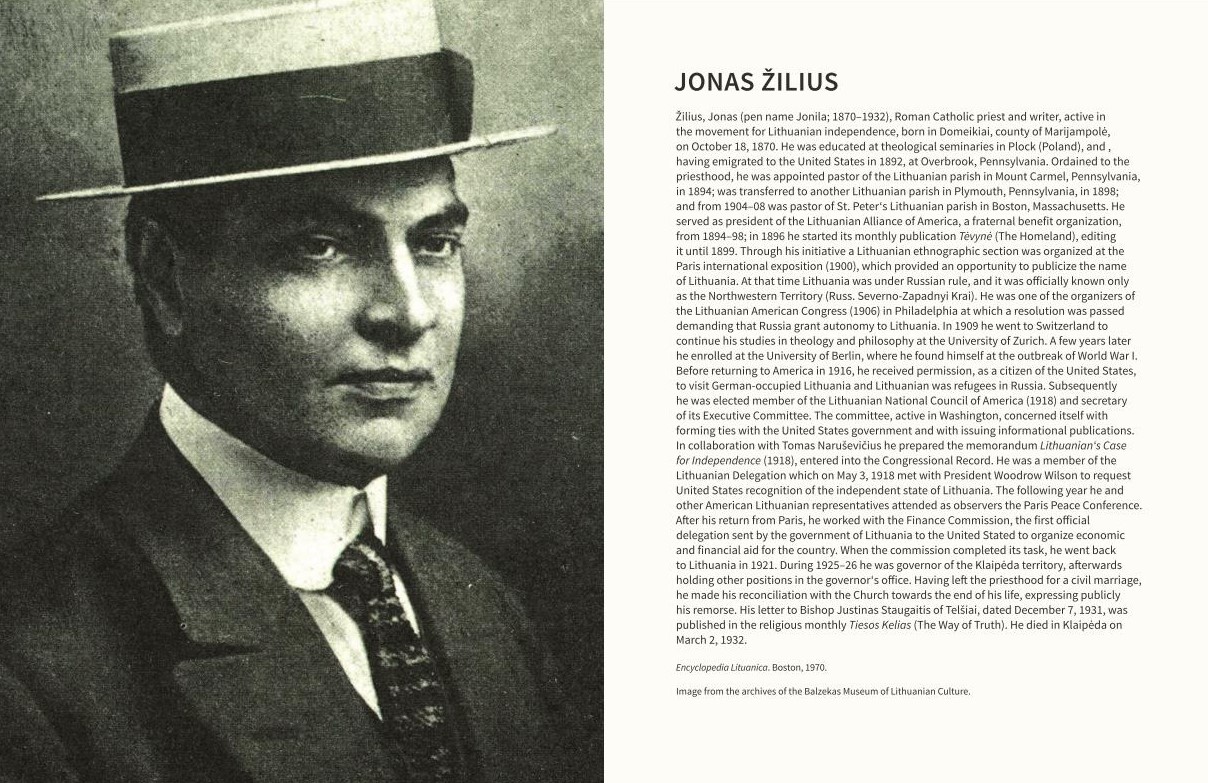
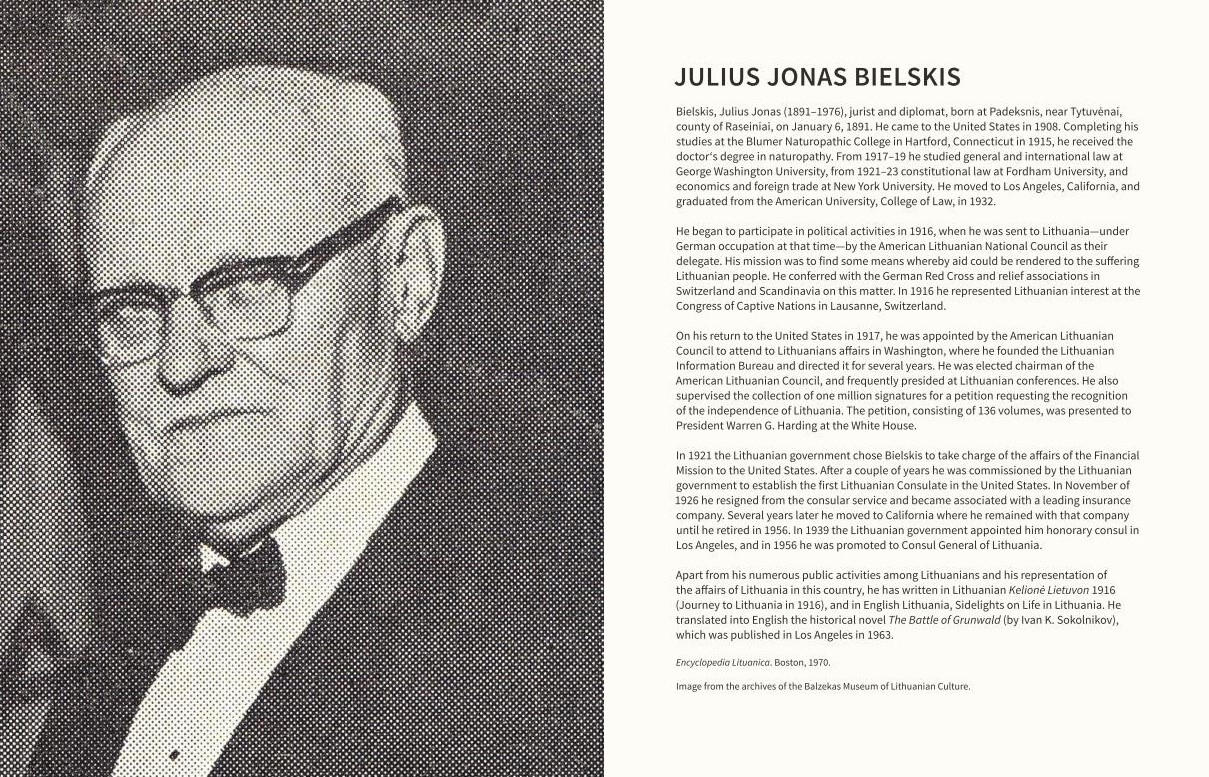
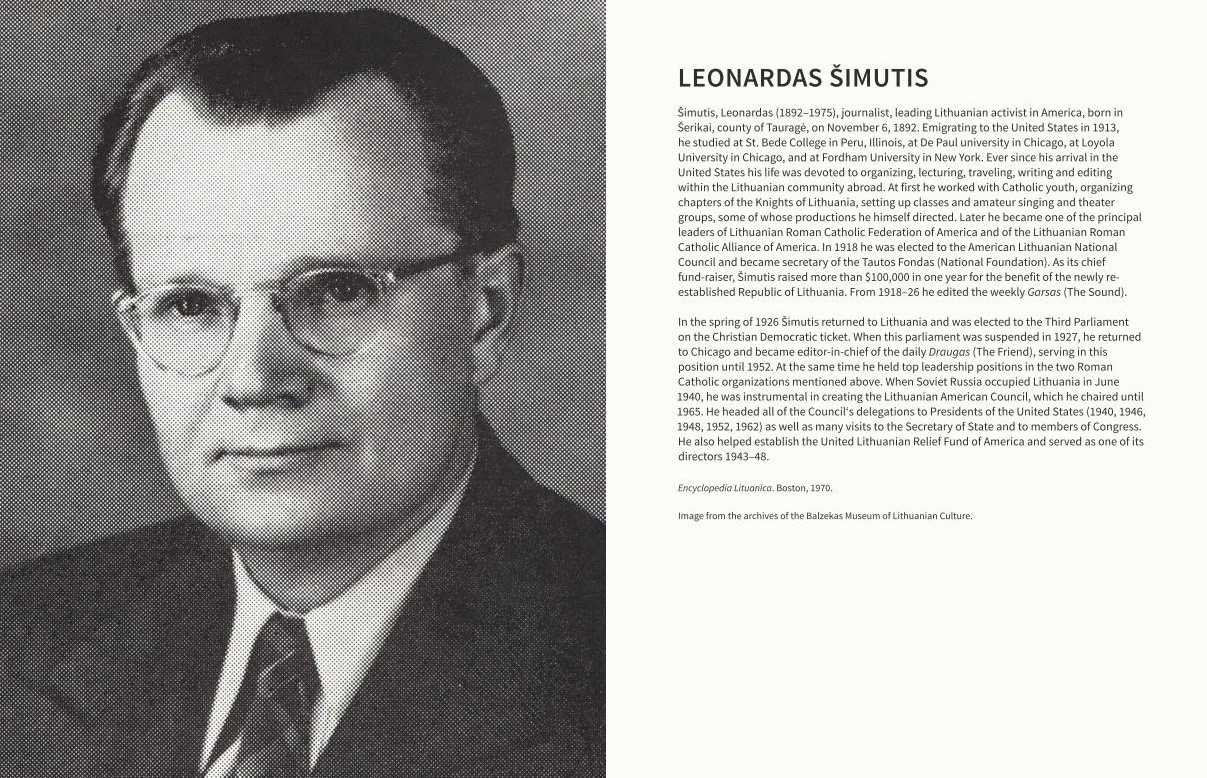
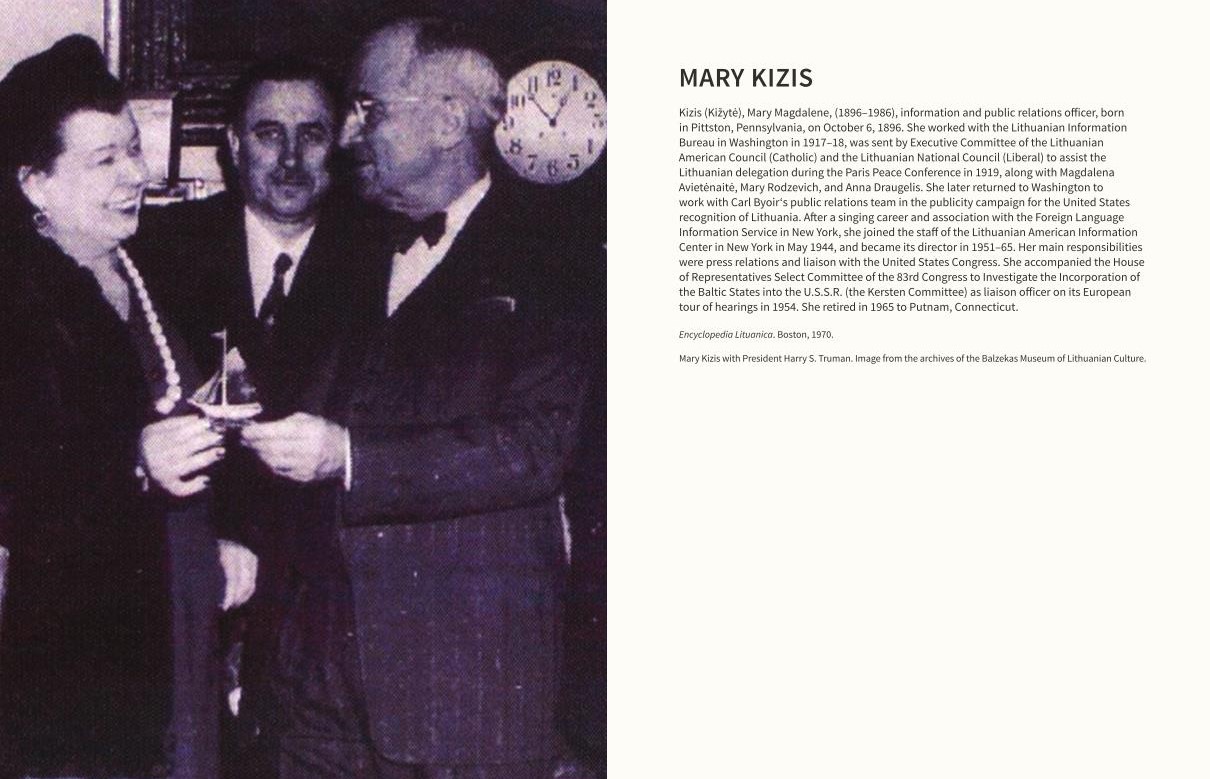
Thousands of Lithuanian Americans contributed to the struggle for Lithuania’s independence and recognition. They supported the effort by giving money to the various campaigns, by fighting to secure the country’s borders at War’s end, and by attending rallies, marches, and events. They participated in letter writing campaigns and in petitions addressed to elected officials and U.S. presidents. Of course, these efforts were directed by many activists and leaders. The following pages provide the images and biographical information for some of those who led the successful effort to secure Lithuanian’s independence and its recognition.
The support of American leaders, politicians, and statesmen was a key factor in the effort to secure recognition for Lithuania. a Lithuanian Americans strategically enlisted the aid of congressmen, senators, diplomats, lobbyists, and even presidents. The following provide three vivid examples of Americans whose initial pages support was transformed into a longer term conviction that the Lithuanian nation deserved recognition and a place among the nations of the world.
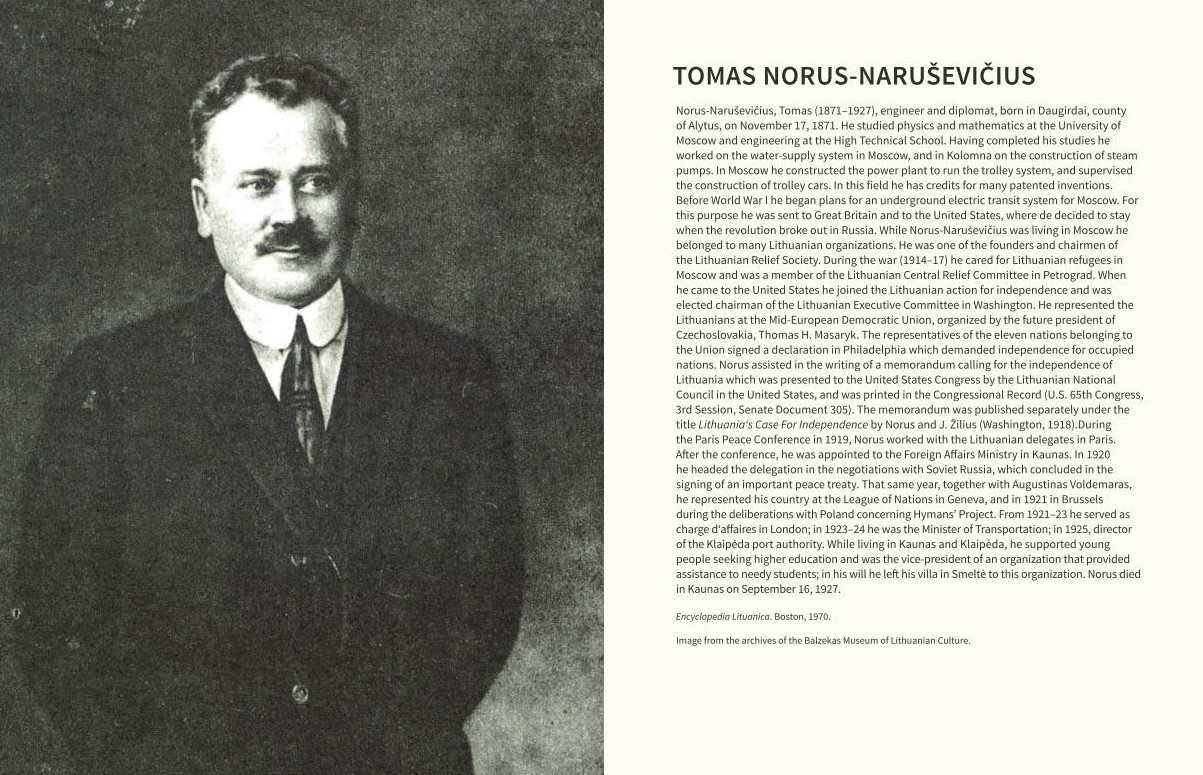
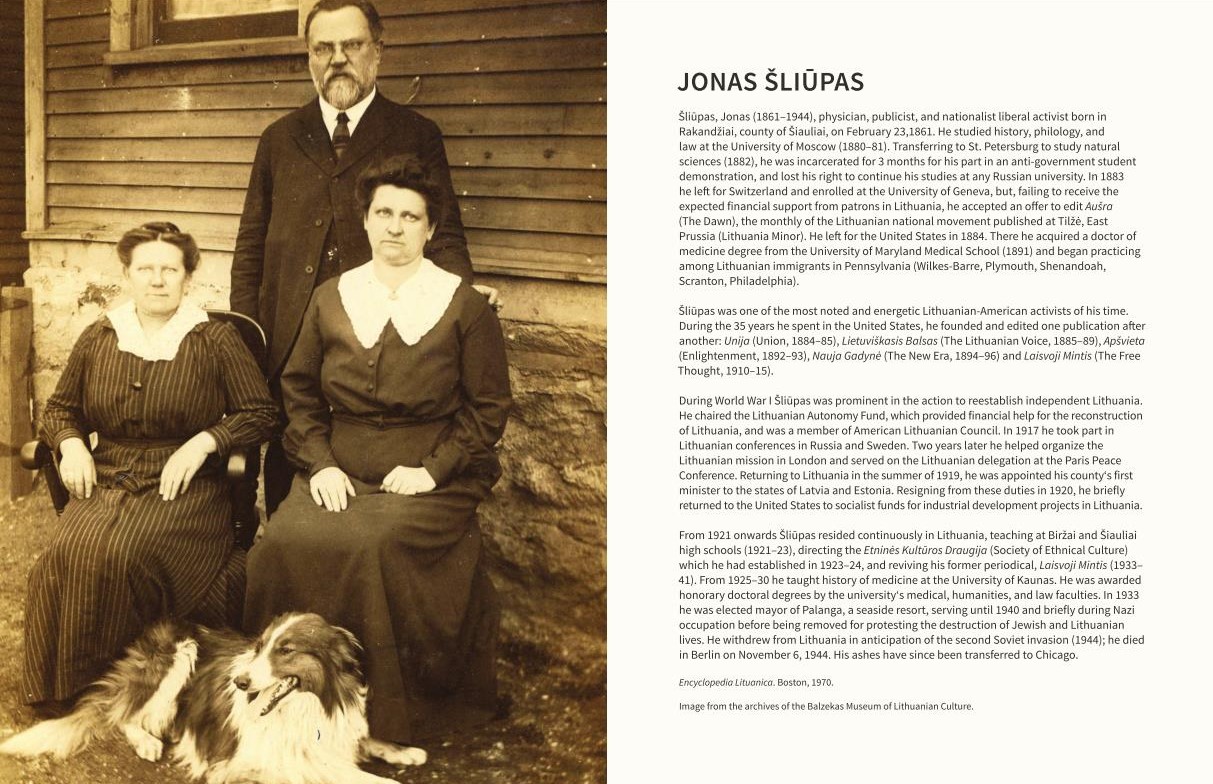
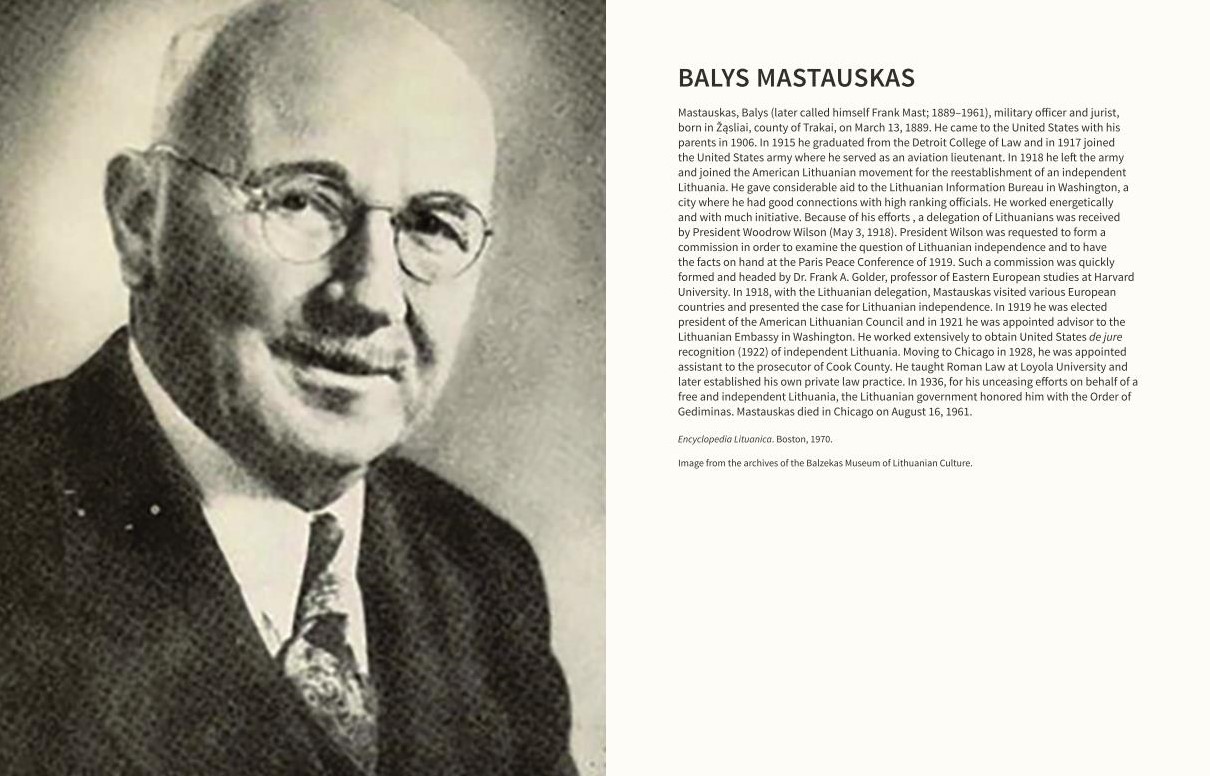
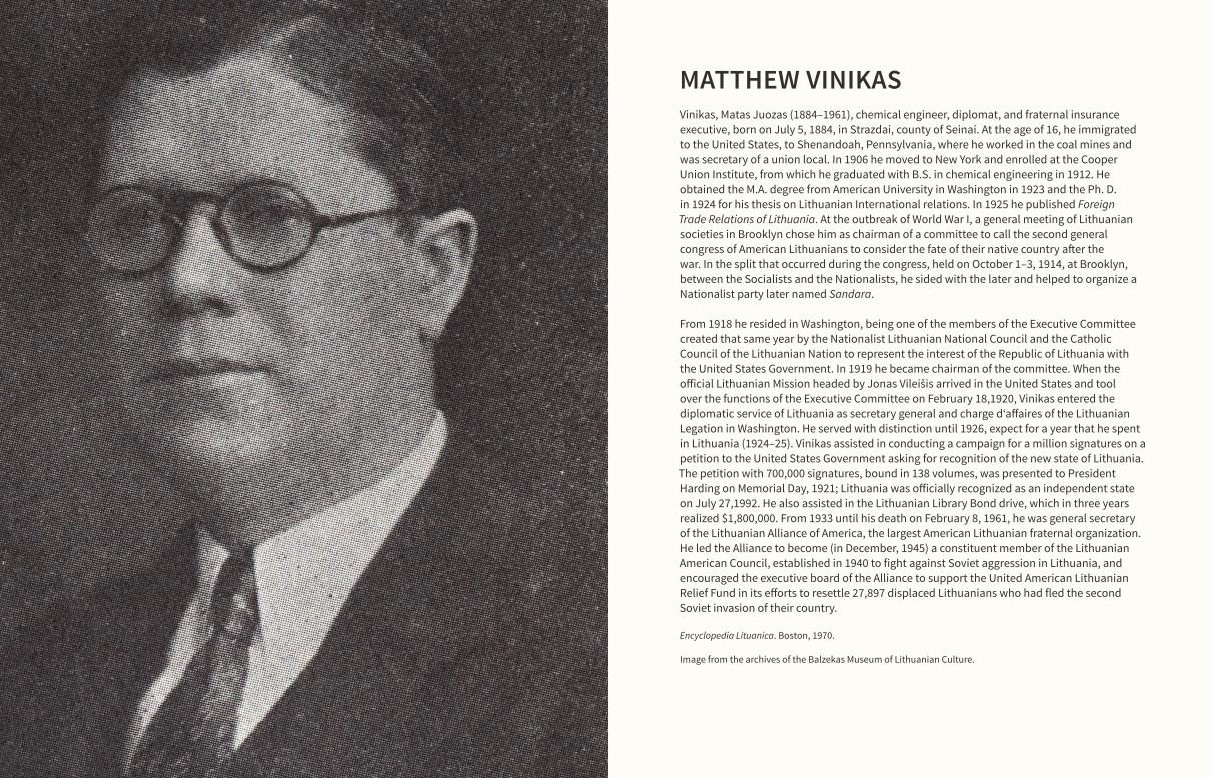
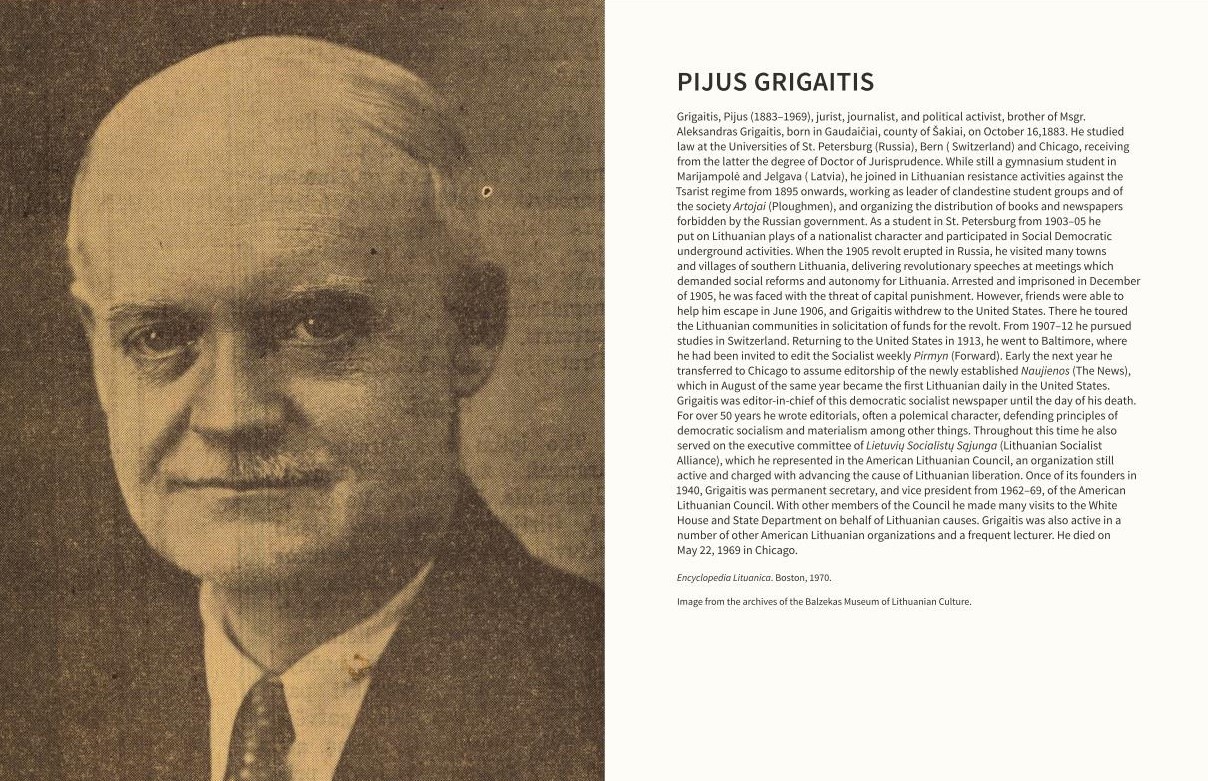
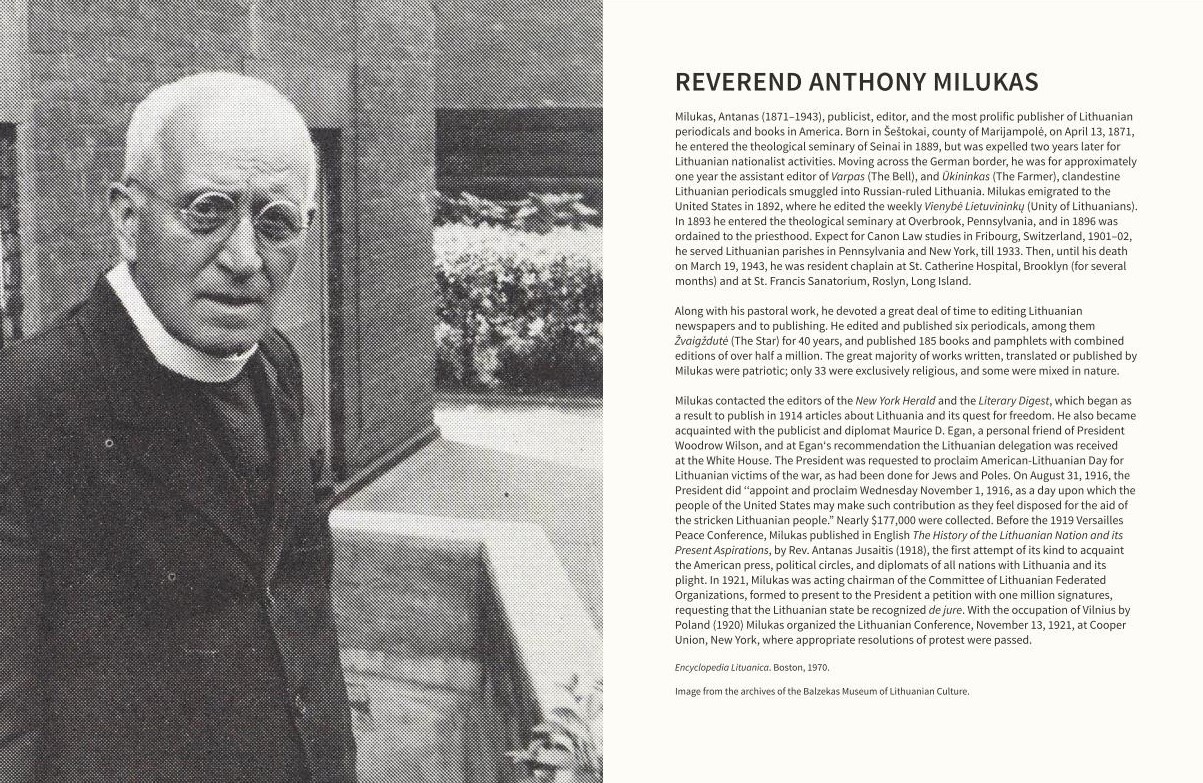
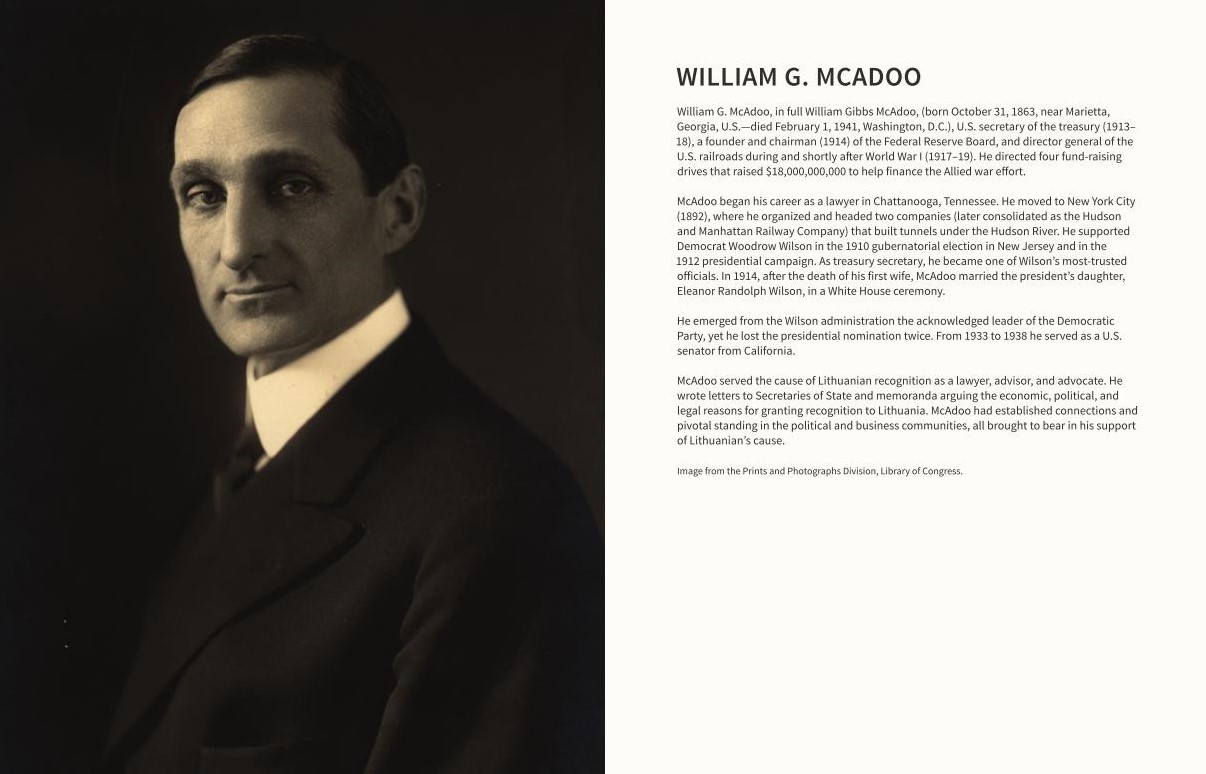
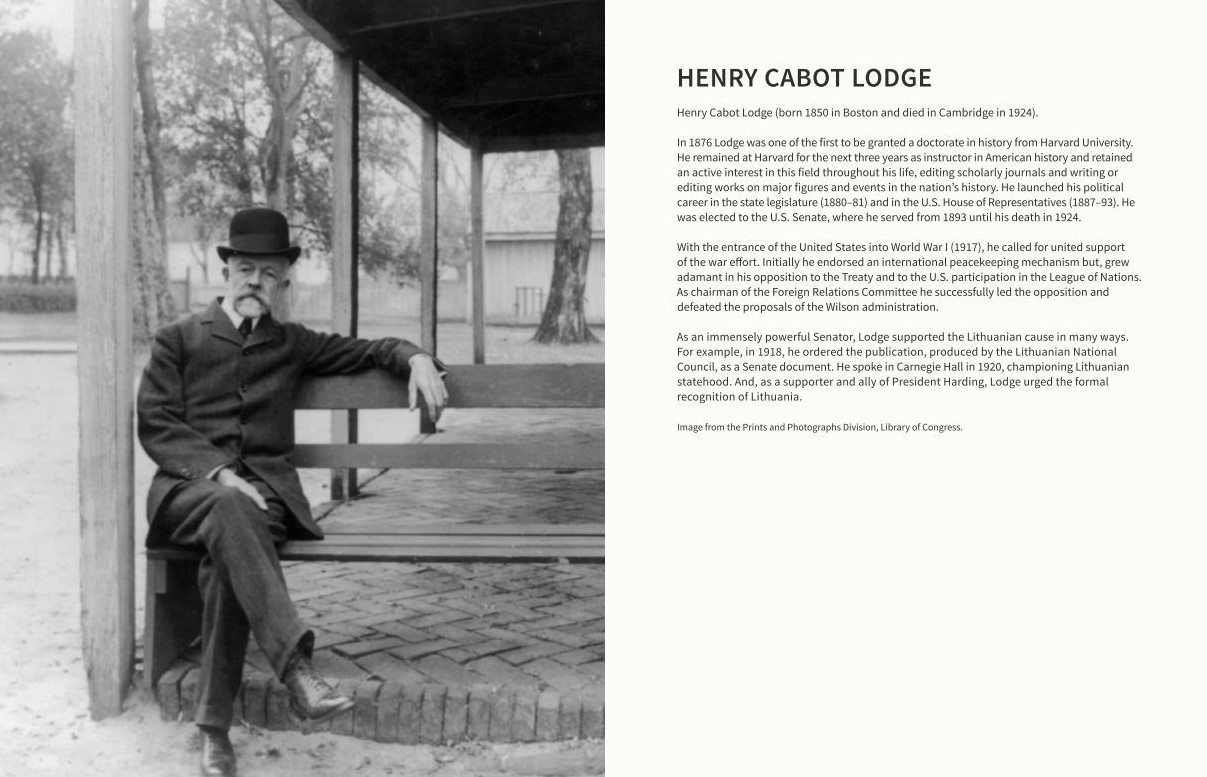
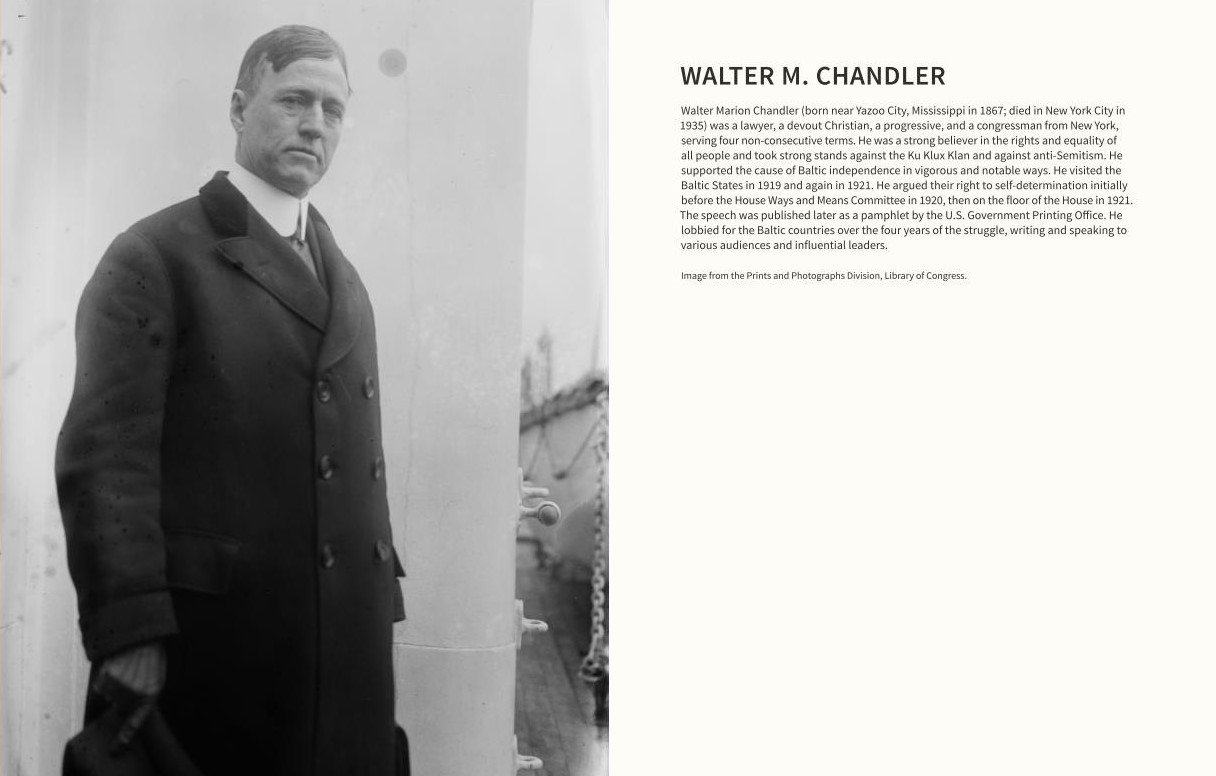
CHARACTERIZING LITHUANIAN SUPPORT
“For Freedom” focuses on the remarkable and persistent support that Lithuanian Americans gave to the cause of Lithuania’s independence. This exhibition acknowledges the many leaders and activists whose skilled oratory, persuasive writing, political abilities, and sheer stamina ensured that the fight for both independence and recognition would be won. Many more made significant contributions than this small exhibition can include. But it is also important to note that these remarkable leaders had the support of a large segment of the Lithuanian American community. Without the aid, dollars, and participation of many unknown and unnamed Lithuanians in America, the leadership would not have been able to provide the support Lithuania needed nor would they have been able to persuade America and the world of the righteousness of their cause.
WAR BONDS BUILD A BOMBER
Lithuanian Americans joined their fellow citizens in supporting and making sacrifices for the World War II military campaigns. This photograph shows a bomber— built by war bonds bought by the Lithuanian American community totaling over a million dollars—named the Lutanica after the plane flown by aviators Darius and Girėnas. In the photograph, a Lithuanian Catholic priest, Anicetas Linkus from Chicago, blesses the new B 19 bomber on July 3, 1943. (66)
MEETING WITH FDR
On October 10, 1940, a delegation of Lithuanians met with President Franklin D. Roosevelt to ask about the fate of Lithuania and U.S. plans regarding it. The delegation included representatives of various émigré organizations. The President expressed his deep empathy for Lithuania’s status and his certainty that Lithuania would once again be free, noting that the countries from which his ancestors came to America were likewise forcibly occupied. In a summary of the meeting, one representative confirmed that the delegated were buoyed by the President’s remarks. (67a,c,d)
From the Franklin Delano Roosevelt Library collections.
WORLD WAR II’S DISPLACED LITHUANIANS
In 1944 as the allied offensive began to end World War II, Soviet armies approached German-held lands from the east. Along with many other nationalities, hundreds of thousands of Lithuanians fled to the west. Having lived one year under Soviet occupation (1940 1941), they sought to escape not only the battlefront but also the death and deportation that would follow the Soviet takeover. Families and individuals fled with very little, packing what they had in blankets, rugs, suitcases, trunks, and crates. This photograph shows Lithuanian refugees in a displaced person camp, probably Hanau. (69)
WELCOME BANQUET FOR A STATESMAN AND PARIOT
On April 19, 1947, Chicago Lithuanians held a banquet to welcome the arrival to America of Kazys Grinius, statesman, diplomat, patriot, and former president of Lithuania. Kazys Grinius (1866–1950) actively fought for independence from Tsarist Russia and helped found the Lithuanian Democrat (Liberal) Party in 1902. After independence, he was a leader of the Lithuanian Peasant Populist Party and was a member of the Constituent Assembly. On June 8, 1920, he formed a cabinet and four days later signed a peace treaty with the Soviet Union. He resigned as prime minister in 1922. Though elected president on June 7, 1926, he was ousted by the military coup d’état that installed a Nationalist government on December 17. When the Germans invaded Lithuania, he refused to be a part of a German-controlled government and condemned Nazi persecution of Lithuanian Jews. He escaped the Soviet occupation in 1944 by fleeing to the west, arriving in the United States in 1947. In the photograph, President Grinius is seated in the center of the table for dignitaries, the last table visible in the photograph. (70)
AFTER PRESENTING A PETITION TO FDR
On March 23, 1945, a delegation of Lithuanian Americans met with President Franklin Delano Roosevelt and presented a million-signature petition, asking for U.S. assurance of continued non-recognition of the Soviet takeover of Lithuania and requesting assistance in re gaining its freedom. That same evening, representatives of many Lithuanian American communities dined with several dozen senators and congressmen in commemoration of the petition and in solidarity with its intended message. The event was at Washington’s Hotel Statler, and the photograph designates the various state delegations. (68)
IN THE SOVIET ERA
Lithuania was occupied by the Soviet Union from 1940 to 1941 and then from 1944 until 1990. During this time, Lithuanians in America, especially those who had fled the Soviet takeover in 1944, learned of their families’ survival and found ways to communicate with their parents, spouses, children, and siblings. For nearly five decades communication was monitored and visits were restricted. But Lithuanian Americans maintained their allegiance to their native or ancestral land and their hope that freedom would return to Lithuania. Lithuanian Americans continued throughout these decades to organize, to protest Soviet occupation, and to meet with politicians and presidents, always pleading that the illegal takeover of Lithuania remain an issue in the international sphere.
MARCHING AGAINST THE SOVIET UNION
Lithuanian Americans exercised their rights to free speech in protesting Soviet occupation. In the first photographs, Lithuanian DPs, along with Latvians, Estonians, Ukrainians, Poles, and others from captive countries, marched in the 1950s, against communism and protesting the annexation of their lands by the Soviet Union.
Young Lithuanian Americans demonstrated publicly for Lithuanian freedom. The young girl in the rear is in national costume, wears an amber necklace and an unmarried girl’s headdress. She represents Lithuania, the Captive Nation.
Collection of the Brokas family. (73a–b, near right and upper far right)
Collection of Mary (Chernis) Urbanckas. Taken from: A Century of Lithuanians in Springfield, Illinois. Best of the Blog by Sandy Baksys.t (73c, lower far right)
A ROSARY MADE OF BREAD
During the Soviet occupations, thousands of Lithuanians were sent to Siberia by the Soviet authorities. Those deported included men, women, and children. Their lives in Siberia were tortuous, filled with hard labor, harsh weather, and little food. Many perished and others survived with health and outlooks impaired. Forced to depart with little or no notice, Siberian deportees had few personal belongings. This, of course, included objects of a religious nature. This rosary was created by a Lithuanian Siberian exilée from pieces of brown bread. On this rosary the owner could pray as was the custom at home. The rosary belonged to Konstancija Stankūnienė and was donated to the Museum by her Lithuanian American relatives, Jonas and Magdalena Stankūnas. (71)
MAIL FROM SIBERIA
Lithuanians deported to Siberia who had relatives in the United States wrote to them, often asking for help and for assistance in reaching other relatives, including those who were still in Lithuania. This letter and postcard were sent by Agota Kašubienė and Marija Kašubaitė-Turutienė to their relatives in New Jersey and Pennsylvania.
The letter states, “My dear uncle. I am writing you from distant Altai…I am asking you to write to my relatives [missing words, probably crossed out by censors] about us and to write to Marijampolė where my mother and your sister live. I am her daughter. Please write to her that I am asking her to send me money….” (72a–b)
LETTER FROM LITHUANIA
Displaced persons living in the U.S. were surprised and overjoyed when correspondence arrived from their closest relatives months after Joseph Stalin’s death. Most did not know how these letters from the U.S.S.R. found their way to addresses in the United States. This letter is one in a series between an uncle in Lithuania, Juozas Kijauskas, and his niece, Irena Brokas, who had come to the U.S. as a DP with her family. In this and other letters, the uncle writes in the English he had learned, and wanted to practice, while living in the U.S. Kijauskas had finished high school in the U.S., but returned to Lithuania after World War I. The uncle and niece corresponded for nearly fifteen years but never met. (74)
HARRY TRUMAN STANDS FOR FREEDOM IN HIS OWN WORDS
Harry Truman assumed the presidency in 1945, after the death of Franklin Roosevelt, as World War II was waning. Under his presidency, the United States led the post war efforts to restore domestic life, shelter the displaced, rebuild ravaged countries, and take a stand against Communist oppression. The concerns he faced are reflected in the notes the President kept on paper called “From the Desk of Harry S. Truman.” Repeatedly, Truman’s notes reflected his growing disgruntlement with opponents of freedom, particularly the Soviet Union. On January 27, 1952, he wrote with his renowned candor:
“There are events in the immediate past which make it perfectly plain that the Soviet Government does not want peace. It has broken every agreement made at Tehran, Yalta, and Potsdam…It must stop and stop now. We of the free world have suffered enough…Give Poland, Estonia, Latvia, Lithuania, Rumania, and Hungary their freedom.”
Sample pages from the January 27, 1952, notes are on display. (76a–c)
From the Harry S. Truman Library collections.
MAINTIANING A DIPLOMATIC PRESENCE IN WASHINGTON DURING THE SOVIET ERA
Because the United States and other western powers never recognized the Soviet takeover, Lithuania and the other Baltic countries continued to have a diplomatic presence. Lithuania maintained its embassy in Washington, D.C., staffed by a charge d’affaires representative for the four and a half decades that elapsed before the restoration of independence in 1990. This article in the Washington Evening Star (published in 1978) outlines the ways that Dr. Stasys Bačkis and his wife handled their duties in the “embassy of a former country.” The Embassy was maintained throughout the Soviet era. Today it is once again the center of Lithuania’s diplomatic presence in the United States. (75c–d)
Clipping from the collection of the Lithuanian Embassy in Washington.
Clipping from the collection of the Lithuanian Embassy in Washington.
MEETING WITH JFK
On February 16, 1962, a group of Lithuanian American activists and leaders met with President John F. Kennedy. In the letter presented to President Kennedy, the delegation eloquently linked their request to the freedom gained after World War I.
“In the struggle for Lithuania’s freedom, the democratic ideals of political liberty, self-government, and the rights of man played an important part. Lithuania’s road toward free statehood was given a vital impetus by President Wilson’s inspiring idea of self determination for all nations. Lithuania’s cause is and remains closely tied to the United States of America by common ideals and beliefs… We are firmly convinced that in the struggle for world supremacy the forces of freedom and democracy will be victorious. Fully endorsing your determination to ‘never fear to negotiate’, we earnestly ask you, Mr. President, at this momentous juncture of world history to consider the problem of the restoration of Lithuania’s independence and freedom as one of the essential prerequisites for the permanent normalization of East-West relations and for the establishment of a just and durable peace in Europe.”
Two days before the meeting, White House Special Assistant Frederick Holborn wrote to Senator Paul Douglas of Illinois, who may have had a role in arranging the meeting. In the letter, Holborn confirmed that the Kennedy administration “maintains the belief that the peoples of the Baltic countries will once again know freedom and national independence.
.
YOUNG LITHUANIAN LEADERS MEET WITH VICE PRESIDENT NIXON
On June 14, 1956, a delegation of young Lithuanian leaders met with then Vice President Nixon to present him with a petition of 40,000 signatures, asking for the restoration of Lithuanian independence and the return of those exiled to Siberia. The meeting was arranged by the Lithuanian National Council (Amerikos Lietuvių Taryba, ALT), several of whom also attended the meeting. The young man on Nixon’s right is Valdas Adamkus. Adamkus returned to Lithuania after the restoration of freedom in 1990 and was Lithuania’s President from 1998 to 2003 and from 2004 to 2009. (76d)
In addition to Adamkus, there are other noted Lithuanians in this image, including from the Lithuanian American Council, starting at the extreme right, are Leonardas Šimutis, Pijus Grigaitis, and Mary Kizis.
Lithuanian American Council: 30 Year Struggle for the This image is from the, published by the Lithuanian American Liberation of Lithuania, 1940–1970 Council in 1971.
FIGHTING FOR LITHUANIA’S FREEDOM THROUGH DIPLOMACY
The career of diplomat and consul general Petras Daužvardis exemplifies the devotion and impact that individual Lithuanian Americans had on the cause of Lithuanian freedom. Born in Latvia, Daužvardis came to the U.S. as a twenty-eight year-old. He earned his law degrees, including a Juris Doctor degree from Georgetown University, before entering Lithuania’s foreign service. Daužvardis first worked in the Ministry of Foreign Affairs, becoming Consul General in Chicago in 1937, a post he held until his death in 1971. Daužvardis’s wife, Josephine, became the consul after her husband’s death. Daužvardis was an experienced and highly regarded diplomat whose writings, speeches, and public dealings reflected his deep devotion to Lithuania’s freedom and opposition to Soviet oppression.
The photo of Petras and Josephine Daužvardis is from the Lithuanian Research and Studies Center. (75a)
The letter on display expresses Daužvardis’s appreciation for the support given by the Balzekas family for Lithuanian Independence Day Celebration in Chicago in 1961. (75b)
A PLEA TO PRESIDENT KENNEDY
Lithuanian Americans, attending the February 16, 1962, meeting, signed a letter to President Kennedy articulating their plea for Lithuania’s freedom.
The signatories included L. Šimutis, E. Bartkus, P. Grigaitis, M. Vaidyla, A. Rudis, P. Dargis, S. Gegužis, J. Grigalius, S. Bredes, Jr., W. T. Kvetkas, V. Abraitis, J. Sonda, M. Kizis, S. Barzdukas, J. Jasaitis, A. Nasvytis, Z. Dailidka, V. Adamkus, A. Kėželis, and A. Varnas.
IN THE STRUGGLE FOR RESTORATION OF INDEPENDENCE
In the late 1980s and into 1990s, the situation in the Soviet Union was not staving off glasnost was changing drastically. Gorbachev’s the desire of conquered nations to be free. Lithuania and the other Baltic countries were pushing hard, singing loudly, and the world was listening. In the U.S., Lithuanian Americans held vigils, marches, and protests in many cities and even on the steps of the U.S. Capitol. Waving flags, speaking and singing, the Lithuanian Americans also wore badges created to magnify the reasons for their activity.
DEDICATED TO THE 1990 PROTESTS
In 2017, two Chicago Lithuanians published a book dedicated to documenting the struggle to obtain freedom from the Soviet Union in 1990. The book acknowledges the multifaceted, energetic, passionate deeds with which Lithuanian Americans once again helped freedom return to Lithuania. The book reprints photos, letters, documents, lists, posters, and other reproducible items, recording for posterity the range of thinking and writing and marching that brought the muchdesired liberty. The book was written and compiled by Pranė Šlutienė and Valentinas Krumplis. (79, upper far right)
Lithuanians demonstrated in Chicago on March 30, 1990. The image of the demonstration was used for a postcard to be distributed with the following message on the back:
“We Want To Be Free. The Lithuanian people do not expect justice, revenge, reparations from the Soviet Union, all we ask for is to return our stolen liberty. We ask Pres. Bush and people in the whole world to say a few words on our behalf to help us gain freedom peacefully.” (80, lower far right)
On June 1, 1990, Lithuanians protested in front of the Capitol. (82, near right)
PROTESTS, BADGES, AND WRITING CAMPAIGNS
On almost every badge, “Freedom” was the word. A collection of the badges from the protest events. (78)
FREEDOM TRIUMPHANT
Some historians have said that freedom is the hallmark of American democracy. If that is so, it helps explain why this was a most promising place for Lithuanian emigres whose own history repeatedly reveals a changing but persistent commitment to freedom. That desire to be free, to pursue life’s opportunities, drove Lithuanians to come to the U.S. Here, their native yearning for freedom was energized and solidified by the founding principles of this country and their pervasive influence. In supporting the struggle for Lithuania’s independence twice in the twentieth century, Lithuanian Americans realized a goal enshrined in the spirit of both their native and adopted lands.
“Lithuanians have inspired the world by building a vibrant democracy and free market economy. Here in America, those who trace their roots to Lithuania have enriched all walks of our national life. As close allies, the United States and Lithuania have an unwavering commitment to our common security, and our partnership will only grow stronger in the years to come.”
–President Barrack Obama’s statement on Lithuanian National Day, February 16, 2011
6
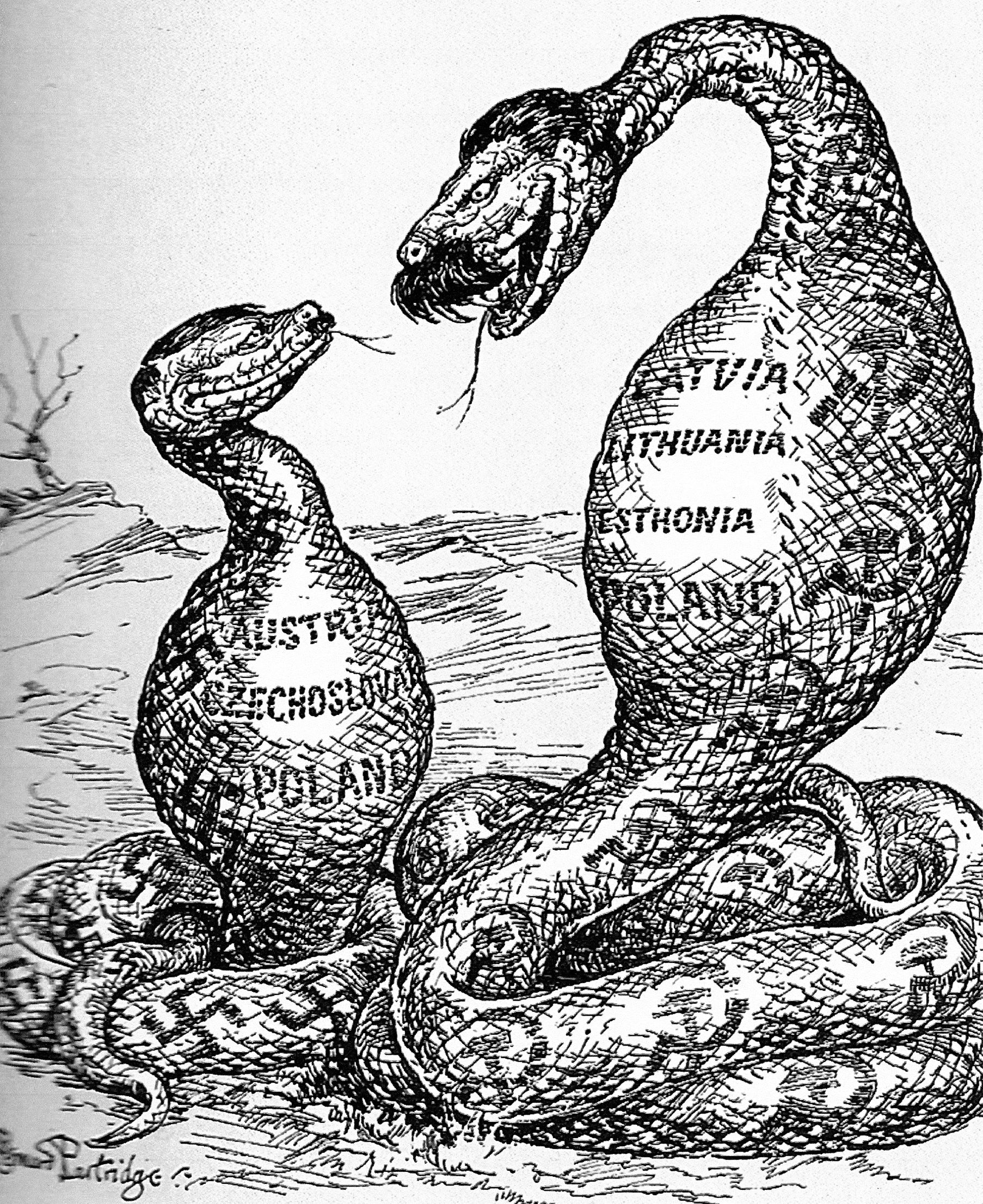
THE TWO CONSTRICTORS
The Stalin snake says, “I don’t know about helping you, Adolf, but I do understand your point of view.”
Bernard Partridge, Punch magazine, 1939
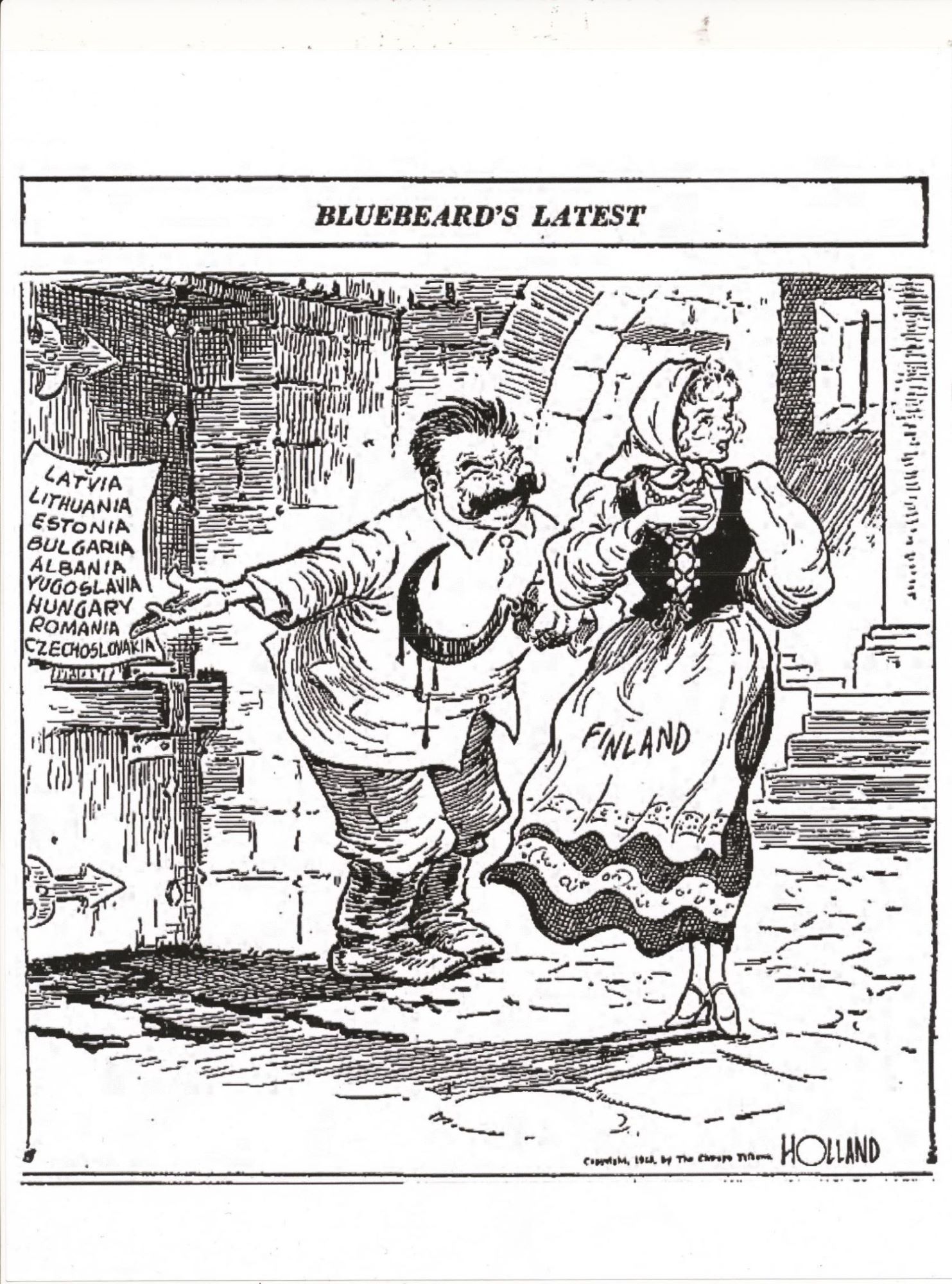
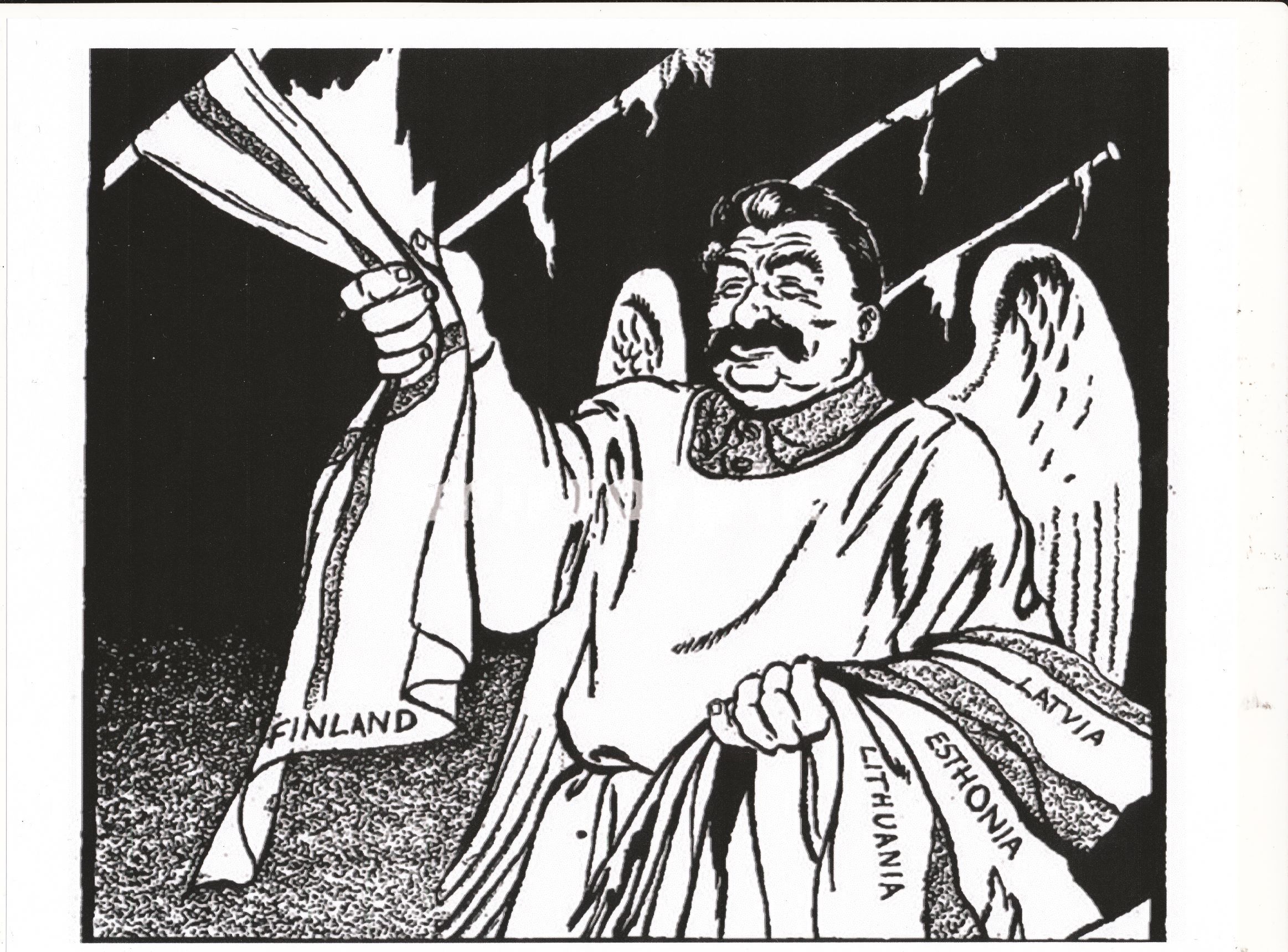
BLUEBEARD’S LATEST
Stalin tries to entice Finland into his castle which already houses Latvia, Lithuania, Estonia, Bulgaria, Albania, Yugoslavia, Hungary, Romania, and Czechoslovakia.
Daniel Edward Holland, perhaps in the Chicago Tribune, circa 1948
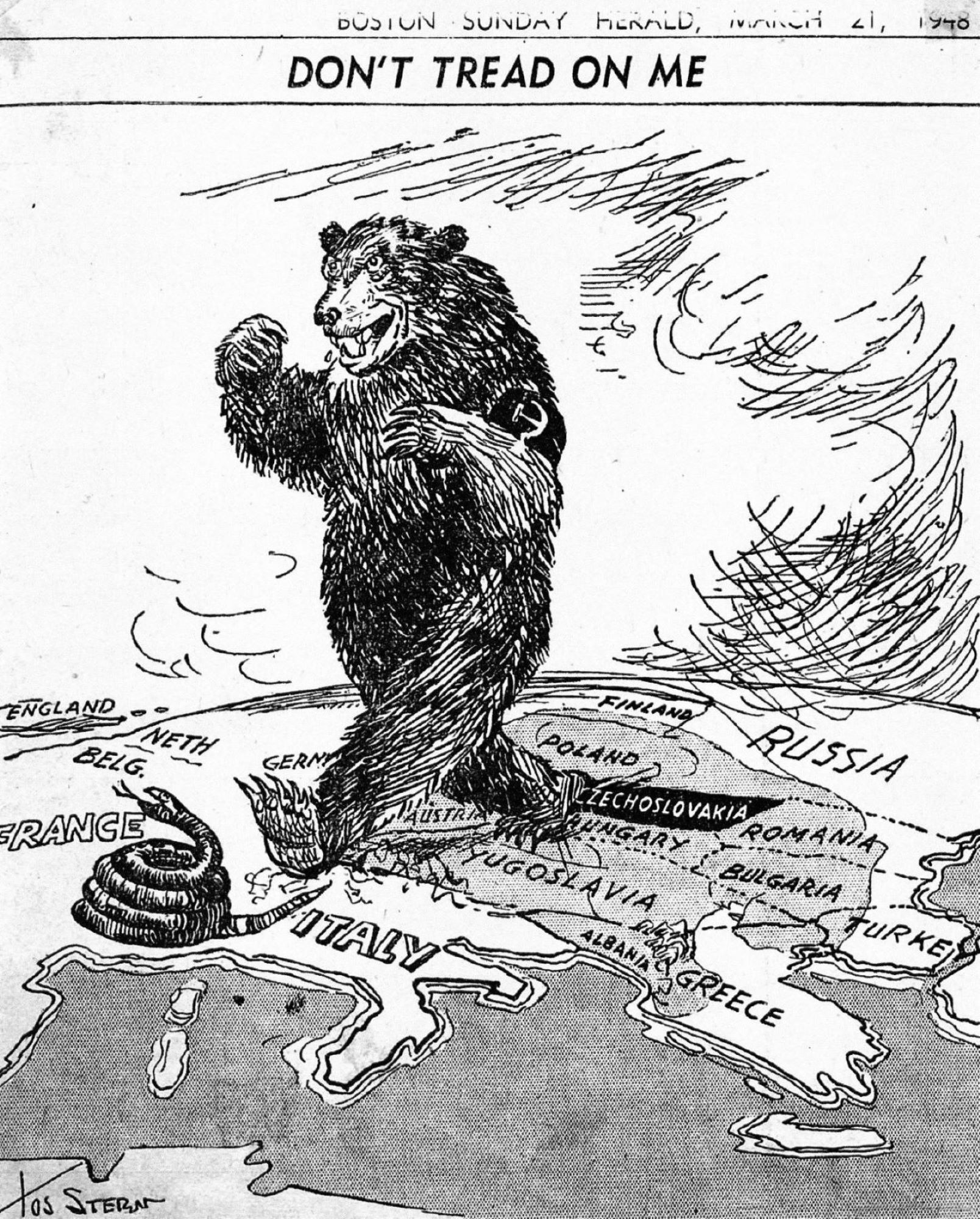
DON’T TREAD ON ME
The Soviet bear, heading west, stomps over the nations of Europe.
Joe Stern, Boston Sunday Herald, March 21, 1948
PEACE BY PIECE
The soviet bear, heading west, stomps over the nations of Europe.
Joe Stern, Boston Sunday Herald, March 21, 1948
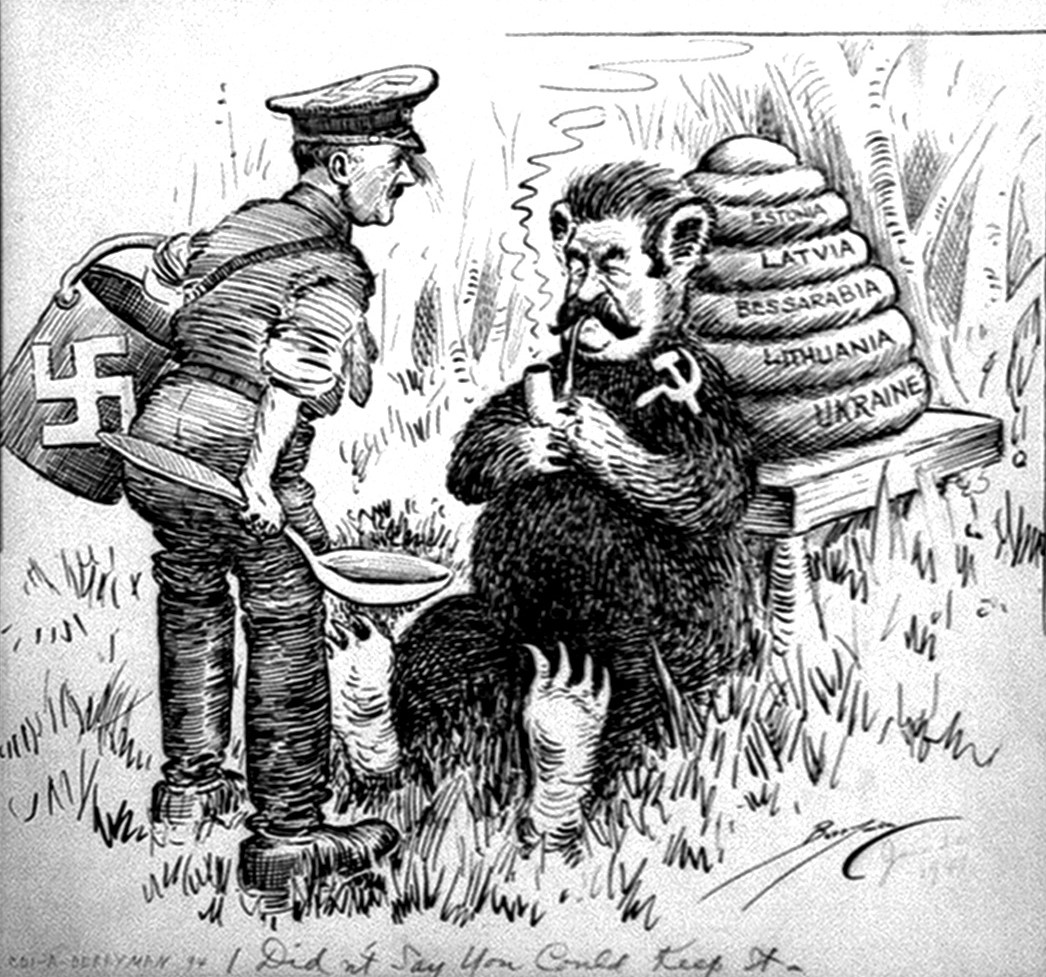
I DIDN’T SAY YOU COULD KEEP IT
Hitler confronts the Stalin bear, sitting in front of a beehive made up of captive countries. This cartoon appeared in print two days before Hitler’s invasion of Soviet-held lands, including the Baltics.
Clifford Kennedy Berryman, probably The Washington Evening Star, June 20, 1941
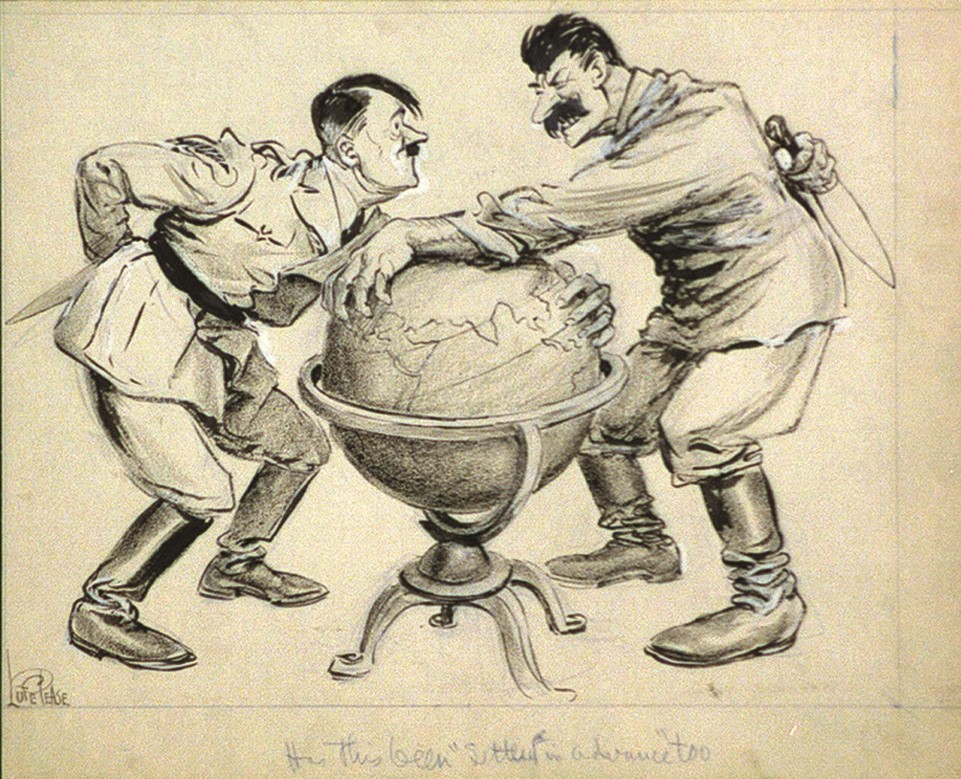
HAS IT BEEN SETTLED IN ADVANCE
Knives drawn, Hitler and Stalin fight over the globe.
Lue Pease, 1939 or 1940
Prints and Photographs Division, Library of Congress
Cartoon Panels
-
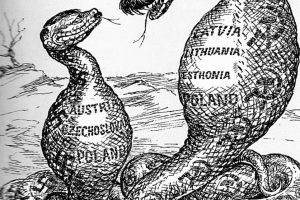
- The Stalin snake says, "I don't know about helping you, Adolf, but I do understand your point of view." Bernard Partridge, Punch magazine, 1939
-
- Stalin tries to entice Finland into his castle, where he already houses Latvia, Lithuania, Estonia, Bulgaria, Albania, Yugoslavia, Hungary, Romania, and Czechoslovakia. Daniel Edward Holland, perhaps in the Chicago Tribune, circa 1948
-
- The Soviet bear, heading west, stomps over the nations of Europe. Joe Stern, Boston Sunday Herald, March 21, 1948
-
- The Soviet bear, heading west, stomps over the nations of Europe. Joe Stern, Boston Sunday Herald, March 21, 1948
-
- Hitler confronts the Stalin bear, sitting in front of a beehive made up of captive countries. This cartoon appeared in print two days before Hitler's invasion of Soviet-held lands, including the Baltics. Clifford Kennedy Berryman, probably The Washington Evening Star, June 20, 19
-
- Knives drawn, Hitler and Stalin fight over the globe. Lue Pease, 1939 or 1940 Prints and Photographs Division, Library of Congress
Visit the Exhibit
Un updated version of the original “For Freedom” exhibition will open at the new Balzekas Museum satellite location ‘Balzekas by the Bean’ on Michigan Av., July 11, 2026.